
Ch. 8 - Techniques of Integration
Hass - Thomas' Calculus 15th Edition
Hass15th EditionThomas' CalculusISBN: 9780137616077Not the one you use?Change textbook
Chapter 8, Problem 8.7.16a

In Exercises 11–22, estimate the minimum number of subintervals needed to approximate the integrals with an error of magnitude less than 10^-4 by (a) the Trapezoidal Rule (The integrals in Exercises 11–18 are the integrals from Exercises 1–8.)
∫ from -1 to 1 of (t³ + 1) dt

Verified step by step guidance
1
Identify the function to be integrated: \(f(t) = t^{3} + 1\) over the interval \([-1, 1]\).
Recall the error bound formula for the Trapezoidal Rule: \(|E_{T}| \leq \frac{(b - a)^{3}}{12 n^{2}} \max_{a \leq x \leq b} |f''(x)|\), where \(n\) is the number of subintervals.
Compute the second derivative of the function: \(f''(t) = \frac{d^{2}}{dt^{2}}(t^{3} + 1) = 6t\).
Determine the maximum absolute value of \(f''(t)\) on the interval \([-1, 1]\): \(\max_{-1 \leq t \leq 1} |6t|\).
Set the error bound less than \(10^{-4}\) and solve the inequality \(\frac{(1 - (-1))^{3}}{12 n^{2}} \max |f''(t)| < 10^{-4}\) for \(n\) to find the minimum number of subintervals needed.

Verified video answer for a similar problem:

This video solution was recommended by our tutors as helpful for the problem above.
Video duration:
9m
Was this helpful?

Key Concepts

Here are the essential concepts you must grasp in order to answer the question correctly.

Trapezoidal Rule

The Trapezoidal Rule is a numerical method to approximate definite integrals by dividing the integration interval into subintervals and approximating the area under the curve as trapezoids. The sum of these trapezoid areas estimates the integral, with accuracy improving as the number of subintervals increases.
Recommended video:

Error Bound for the Trapezoidal Rule

The error bound for the Trapezoidal Rule depends on the second derivative of the integrand. Specifically, the error magnitude is at most (K(b - a)^3) / (12n^2), where K is the maximum absolute value of the second derivative on [a, b], and n is the number of subintervals. This formula helps estimate how many subintervals are needed to achieve a desired accuracy.
Recommended video:
04:57
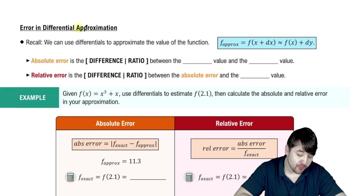
Determining Error and Relative Error

Second Derivative and Its Role in Error Estimation

The second derivative of the function indicates the concavity and affects the accuracy of the Trapezoidal Rule. A larger maximum second derivative on the interval means greater potential error, requiring more subintervals for a precise approximation. Calculating or bounding this derivative is essential for applying the error formula.
Recommended video:
06:02
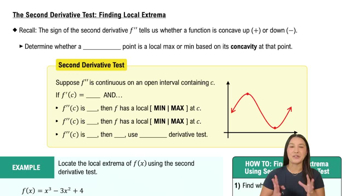
The Second Derivative Test: Finding Local Extrema