
Textbook Question
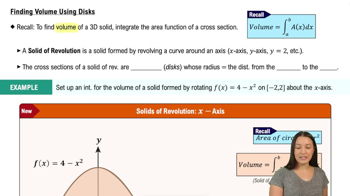
88. The region in Exercise 87 is revolved about the x-axis to generate a solid.
b. Show that the inner and outer surfaces of the solid have infinite area.
1
views

 Verified step by step guidance
 04:48
04:48
 07:33
07:33 6:04
6:0488. The region in Exercise 87 is revolved about the x-axis to generate a solid.
b. Show that the inner and outer surfaces of the solid have infinite area.
In Exercises 11–22, estimate the minimum number of subintervals needed to approximate the integrals with an error of magnitude less than 10^-4 by (a) the Trapezoidal Rule (The integrals in Exercises 11–18 are the integrals from Exercises 1–8.)
∫ from 0 to 2 of sin(x + 1) dx
In Exercises 11–22, estimate the minimum number of subintervals needed to approximate the integrals with an error of magnitude less than 10^-4 by (a) the Trapezoidal Rule (The integrals in Exercises 11–18 are the integrals from Exercises 1–8.)
∫ from -2 to 0 of (x² - 1) dx
In Exercises 11–22, estimate the minimum number of subintervals needed to approximate the integrals with an error of magnitude less than 10^-4 by (a) the Trapezoidal Rule (The integrals in Exercises 11–18 are the integrals from Exercises 1–8.)
∫ from 0 to 3 of 1/√(x + 1) dx
In Exercises 11–22, estimate the minimum number of subintervals needed to approximate the integrals with an error of magnitude less than 10^-4 by (b) Simpson’s Rule. (The integrals in Exercises 11–18 are the integrals from Exercises 1–8.)
∫ from 0 to 3 of 1/√(x + 1) dx
In Exercises 11–22, estimate the minimum number of subintervals needed to approximate the integrals with an error of magnitude less than 10^-4 by (b) Simpson’s Rule. (The integrals in Exercises 11–18 are the integrals from Exercises 1–8.)
∫ from -1 to 1 of (x² + 1) dx