
Textbook Question
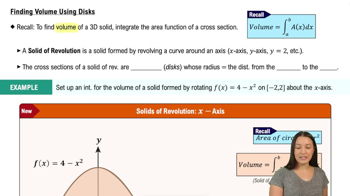
88. The region in Exercise 87 is revolved about the x-axis to generate a solid.
a. Find the volume of the solid.
1
views

 Verified step by step guidance
 04:48
04:48
 07:33
07:33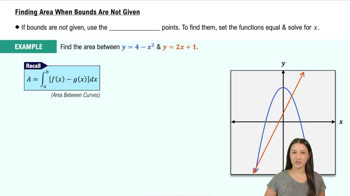 05:06
05:0688. The region in Exercise 87 is revolved about the x-axis to generate a solid.
a. Find the volume of the solid.
Lifetime of a tire Assume the random variable L in Example 2f is normally distributed with mean μ = 22,000 miles and σ = 4,000 miles.
a. In a batch of 4000 tires, how many can be expected to last for at least 18,000 miles?
In Exercises 11–22, estimate the minimum number of subintervals needed to approximate the integrals with an error of magnitude less than 10^-4 by (a) the Trapezoidal Rule (The integrals in Exercises 11–18 are the integrals from Exercises 1–8.)
∫ from 1 to 3 of (2x - 1) dx
In Exercises 11–22, estimate the minimum number of subintervals needed to approximate the integrals with an error of magnitude less than 10^-4 by (a) the Trapezoidal Rule (The integrals in Exercises 11–18 are the integrals from Exercises 1–8.)
∫ from 0 to 2 of (t³ + t) dt
Evaluate ∫ sec θ dθ by:
a. Multiplying by (sec θ + tan θ) / (sec θ + tan θ) and then using a u-substitution.
Centroid:
Find the centroid of the region cut from the first quadrant by the curve
y = 1/√(x + 1) and the line x = 3.