Ch. 8 - Techniques of Integration
Hass - Thomas' Calculus 15th Edition
Hass15th EditionThomas' CalculusISBN: 9780137616077Not the one you use?Change textbook
Chapter 8, Problem 8.9.18

Find the value of the constant c so that the given function is a probability density function for a random variable X over the specified interval.
f(x) = (1/x) over [c, c + 1]

Verified step by step guidance
1
Recall that for a function \(f(x)\) to be a probability density function (pdf) over an interval \([a, b]\), it must satisfy the condition: \(\int_a^b f(x) \, dx = 1\).
In this problem, the function is \(f(x) = \frac{1}{x}\) defined over the interval \([c, c+1]\). We need to find the value of \(c\) such that \(\int_c^{c+1} \frac{1}{x} \, dx = 1\).
Set up the integral: \(\int_c^{c+1} \frac{1}{x} \, dx = \left[ \ln|x| \right]_c^{c+1} = \ln(c+1) - \ln(c)\).
Use the logarithm property to combine the difference: \(\ln(c+1) - \ln(c) = \ln\left( \frac{c+1}{c} \right)\).
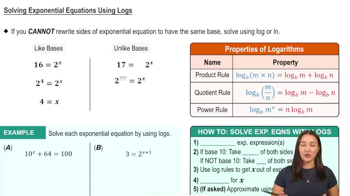
Set the integral equal to 1 and solve for \(c\): \(\ln\left( \frac{c+1}{c} \right) = 1\). From here, exponentiate both sides to isolate \(c\) and solve the resulting equation.

Verified video answer for a similar problem:

This video solution was recommended by our tutors as helpful for the problem above.
Video duration:
6m
Was this helpful?

Key Concepts

Here are the essential concepts you must grasp in order to answer the question correctly.

Probability Density Function (PDF)

A probability density function describes the likelihood of a continuous random variable taking on a specific value. For a function to be a valid PDF, it must be non-negative over its domain and its total integral over the specified interval must equal 1.
Recommended video:
06:21
Properties of Functions

Definite Integral and Area Under the Curve

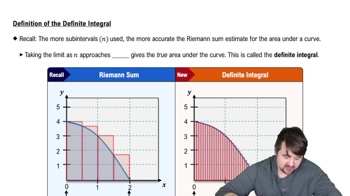
The definite integral of a function over an interval represents the area under its curve between two points. In the context of PDFs, integrating the function over its domain must yield 1, ensuring the total probability sums to one.
Recommended video:
05:43
Definition of the Definite Integral

Solving for Constants Using Integral Equations

When a function includes an unknown constant, we use integral equations to solve for it by setting the integral equal to 1 (for PDFs). This involves integrating the function with the constant over the interval and solving the resulting equation.
Recommended video:
5:47
Solving Exponential Equations Using Logs