Ch. 8 - Techniques of Integration
Hass - Thomas' Calculus 15th Edition
Hass15th EditionThomas' CalculusISBN: 9780137616077Not the one you use?Change textbook
Chapter 8, Problem 8.3.58

Evaluate the integrals in Exercises 53–58.
∫ from -π/2 to π/2 of cos(x) cos(7x) dx

Verified step by step guidance
1
Recognize that the integral involves the product of two cosine functions: \(\cos(x)\) and \(\cos(7x)\), integrated over the interval \([-\frac{\pi}{2}, \frac{\pi}{2}]\).
Use the product-to-sum identity for cosine functions: \(\cos A \cos B = \frac{1}{2} [\cos(A - B) + \cos(A + B)]\). Applying this, rewrite the integrand as \(\frac{1}{2} [\cos(x - 7x) + \cos(x + 7x)] = \frac{1}{2} [\cos(-6x) + \cos(8x)]\).
Since cosine is an even function, \(\cos(-6x) = \cos(6x)\), so the integrand simplifies to \(\frac{1}{2} [\cos(6x) + \cos(8x)]\).
Split the integral into two separate integrals: \(\frac{1}{2} \int_{-\frac{\pi}{2}}^{\frac{\pi}{2}} \cos(6x) \, dx + \frac{1}{2} \int_{-\frac{\pi}{2}}^{\frac{\pi}{2}} \cos(8x) \, dx\).
Evaluate each integral by finding the antiderivative of cosine, which is sine divided by the coefficient of \(x\), and then apply the limits of integration \(-\frac{\pi}{2}\) to \(\frac{\pi}{2}\) for each term.

Verified video answer for a similar problem:

This video solution was recommended by our tutors as helpful for the problem above.
Video duration:
9m
Was this helpful?

Key Concepts

Here are the essential concepts you must grasp in order to answer the question correctly.

Definite Integrals

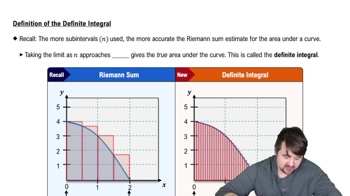
A definite integral calculates the net area under a curve between two specified limits. It is evaluated by finding the antiderivative of the integrand and then applying the Fundamental Theorem of Calculus to compute the difference at the upper and lower bounds.
Recommended video:
05:43
Definition of the Definite Integral

Product-to-Sum Trigonometric Identities

These identities transform products of trigonometric functions into sums or differences, simplifying integration. For example, cos(A)cos(B) = ½[cos(A−B) + cos(A+B)], which helps break down complex integrals into easier terms.
Recommended video:
7:17
Verifying Trig Equations as Identities

Symmetry of Trigonometric Functions

Understanding whether a function is even, odd, or neither helps simplify definite integrals over symmetric intervals. Cosine is an even function, so integrals from -a to a can be simplified by doubling the integral from 0 to a.
Recommended video:
6:04
Introduction to Trigonometric Functions