

Ch. 8 - Techniques of Integration
Hass - Thomas' Calculus 15th Edition
Hass15th EditionThomas' CalculusISBN: 9780137616077Not the one you use?Change textbook
Chapter 8, Problem 8.3.56

Evaluate the integrals in Exercises 53–58.
∫ from 0 to π/2 of sin(x) cos(x) dx

Verified step by step guidance
1
Recognize that the integral is \( \int_0^{\frac{\pi}{2}} \sin(x) \cos(x) \, dx \). This is a definite integral with limits from 0 to \( \frac{\pi}{2} \).
Use a trigonometric identity or substitution to simplify the integrand. One useful identity is \( \sin(2x) = 2 \sin(x) \cos(x) \), so \( \sin(x) \cos(x) = \frac{1}{2} \sin(2x) \).
Rewrite the integral using this identity: \( \int_0^{\frac{\pi}{2}} \sin(x) \cos(x) \, dx = \int_0^{\frac{\pi}{2}} \frac{1}{2} \sin(2x) \, dx \).
Factor out the constant \( \frac{1}{2} \) from the integral: \( \frac{1}{2} \int_0^{\frac{\pi}{2}} \sin(2x) \, dx \).
Perform a substitution to integrate \( \sin(2x) \): let \( u = 2x \), then \( du = 2 dx \) or \( dx = \frac{du}{2} \). Change the limits accordingly and integrate \( \sin(u) \) with respect to \( u \).

Verified video answer for a similar problem:

This video solution was recommended by our tutors as helpful for the problem above.
Video duration:
3m
Was this helpful?

Key Concepts

Here are the essential concepts you must grasp in order to answer the question correctly.

Definite Integrals

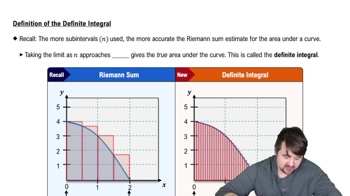
A definite integral calculates the net area under a curve between two specific limits. It is represented as ∫ from a to b of f(x) dx, where a and b are the lower and upper bounds. Evaluating definite integrals involves finding the antiderivative and then applying the Fundamental Theorem of Calculus.
Recommended video:
05:43
Definition of the Definite Integral

Trigonometric Identities

Trigonometric identities are equations involving trigonometric functions that hold true for all values in their domains. For example, the product-to-sum identity sin(x)cos(x) = (1/2)sin(2x) simplifies integration by converting products into sums, making the integral easier to evaluate.
Recommended video:
7:17
Verifying Trig Equations as Identities

Fundamental Theorem of Calculus

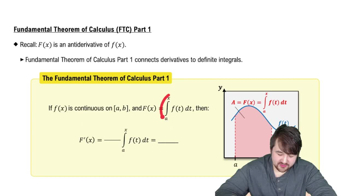
This theorem links differentiation and integration, stating that if F is an antiderivative of f on [a, b], then ∫ from a to b of f(x) dx = F(b) - F(a). It allows us to evaluate definite integrals by finding antiderivatives and computing their difference at the bounds.
Recommended video:
06:11
Fundamental Theorem of Calculus Part 1