Ch. 8 - Techniques of Integration
Hass - Thomas' Calculus 15th Edition
Hass15th EditionThomas' CalculusISBN: 9780137616077Not the one you use?Change textbook
Chapter 8, Problem 8.2.24

Evaluate the integrals in Exercises 1–24 using integration by parts.
∫ e^(-2x) sin(2x) dx

Verified step by step guidance
1
Identify the integral to solve: \(\int e^{-2x} \sin(2x) \, dx\).
Recall the integration by parts formula: \(\int u \, dv = uv - \int v \, du\).
Choose \(u\) and \(dv\) wisely. For this integral, let \(u = \sin(2x)\) and \(dv = e^{-2x} dx\).
Compute \(du\) and \(v\): differentiate \(u\) to get \(du = 2 \cos(2x) \, dx\), and integrate \(dv\) to get \(v = \int e^{-2x} dx = -\frac{1}{2} e^{-2x}\).
Apply the integration by parts formula: substitute \(u\), \(v\), \(du\) into \(\int u \, dv = uv - \int v \, du\), then simplify the resulting integral. You may need to apply integration by parts a second time or use algebraic manipulation to solve for the original integral.

Verified video answer for a similar problem:

This video solution was recommended by our tutors as helpful for the problem above.
Video duration:
5m
Was this helpful?

Key Concepts

Here are the essential concepts you must grasp in order to answer the question correctly.

Integration by Parts

Integration by parts is a technique based on the product rule for differentiation. It transforms the integral of a product of functions into simpler integrals using the formula ∫u dv = uv - ∫v du. Choosing u and dv wisely is crucial to simplify the integral effectively.
Recommended video:
06:18
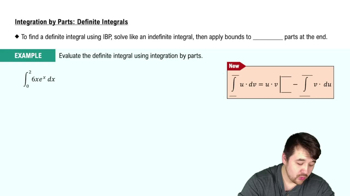
Integration by Parts for Definite Integrals

Integration of Exponential and Trigonometric Functions

Integrals involving products of exponential and trigonometric functions often require repeated application of integration by parts. Recognizing patterns and using algebraic manipulation helps to solve these integrals, sometimes leading to an equation involving the original integral.
Recommended video:
05:11
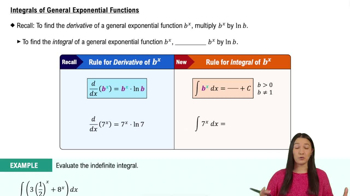
Integrals of General Exponential Functions

Solving for the Original Integral

When integration by parts leads back to the original integral, you can solve for it algebraically. This involves setting up an equation where the integral appears on both sides and isolating it to find its value, a common strategy for integrals like ∫e^(ax) sin(bx) dx.
Recommended video:
5:59
Graph Hyperbolas NOT at the Origin