
Ch. 8 - Techniques of Integration
Hass - Thomas' Calculus 15th Edition
Hass15th EditionThomas' CalculusISBN: 9780137616077Not the one you use?Change textbook
Chapter 8, Problem 8.PE.57

Evaluate the improper integrals in Exercises 53–62.
∫ from 3 to ∞ of (2 / (u² − 2u)) du

Verified step by step guidance
1
First, recognize that the integral is improper because the upper limit is infinity. So, rewrite the integral as a limit: \(\displaystyle \int_{3}^{\infty} \frac{2}{u^{2} - 2u} \, du = \lim_{t \to \infty} \int_{3}^{t} \frac{2}{u^{2} - 2u} \, du\).
Next, factor the denominator to simplify the integrand: \(u^{2} - 2u = u(u - 2)\). So the integrand becomes \(\frac{2}{u(u - 2)}\).
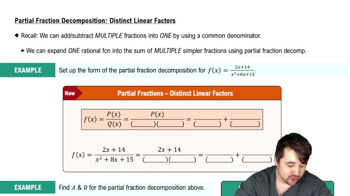
Use partial fraction decomposition to express \(\frac{2}{u(u - 2)}\) as \(\frac{A}{u} + \frac{B}{u - 2}\). Set up the equation \(2 = A(u - 2) + Bu\) and solve for constants \(A\) and \(B\).
After finding \(A\) and \(B\), rewrite the integral as the sum of two simpler integrals: \(\int \frac{A}{u} \, du + \int \frac{B}{u - 2} \, du\). Integrate each term separately to get logarithmic functions.
Finally, substitute the limits from 3 to \(t\), then take the limit as \(t\) approaches infinity. Evaluate the resulting expression to determine if the improper integral converges or diverges.

Verified video answer for a similar problem:

This video solution was recommended by our tutors as helpful for the problem above.
Video duration:
6m
Was this helpful?

Key Concepts

Here are the essential concepts you must grasp in order to answer the question correctly.

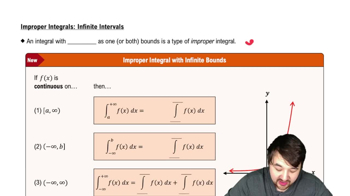
Improper Integrals

Improper integrals involve integration over an infinite interval or where the integrand has an infinite discontinuity. To evaluate them, the integral is expressed as a limit, such as taking the limit as the upper bound approaches infinity. This approach ensures the integral converges to a finite value or diverges.
Recommended video:
11:11
Improper Integrals: Infinite Intervals

Partial Fraction Decomposition

Partial fraction decomposition breaks a rational function into simpler fractions that are easier to integrate. For example, a function like 2/(u² − 2u) can be rewritten as a sum of fractions with linear denominators, facilitating straightforward integration of each term.
Recommended video:
10:07
Partial Fraction Decomposition: Distinct Linear Factors

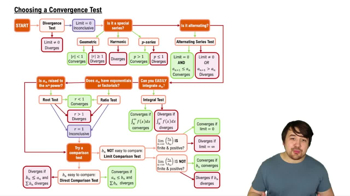
Limits and Convergence of Integrals

Evaluating improper integrals requires analyzing the limit of the integral as the variable approaches infinity. Determining whether this limit exists (converges) or not (diverges) is crucial. Convergence means the area under the curve is finite, allowing the integral to be assigned a value.
Recommended video:
07:51
Choosing a Convergence Test