Ch. 8 - Techniques of Integration
Hass - Thomas' Calculus 15th Edition
Hass15th EditionThomas' CalculusISBN: 9780137616077Not the one you use?Change textbook
Chapter 8, Problem 8.8.81a

81. Find the values of p for which each integral converges.
a. ∫ from 1 to 2 of [dx / (x (ln x)^p)]

Verified step by step guidance
1
Identify the integral and the parameter involved: we have the integral \( \int_1^2 \frac{dx}{x (\ln x)^p} \), and we want to find for which values of \( p \) this integral converges.
Check the behavior of the integrand near the limits of integration. Since the interval is from 1 to 2, and \( \ln 1 = 0 \), the potential issue is at the lower limit \( x = 1 \) where the denominator involves \( (\ln x)^p \) which tends to zero, possibly causing a singularity.
Make a substitution to analyze the behavior near \( x = 1 \): let \( t = \ln x \). Then \( dt = \frac{1}{x} dx \), so \( dx = x dt = e^t dt \). The integral limits change from \( x=1 \) to \( t=0 \), and from \( x=2 \) to \( t=\ln 2 \).
Rewrite the integral in terms of \( t \): \( \int_0^{\ln 2} \frac{e^t dt}{e^t t^p} = \int_0^{\ln 2} \frac{dt}{t^p} \). Now the integral simplifies to \( \int_0^{\ln 2} t^{-p} dt \).
Determine convergence of \( \int_0^{a} t^{-p} dt \) for some positive \( a \). This integral converges if and only if \( -p > -1 \), or equivalently \( p < 1 \). So the original integral converges for \( p < 1 \).

Verified video answer for a similar problem:

This video solution was recommended by our tutors as helpful for the problem above.
Video duration:
6m
Was this helpful?

Key Concepts

Here are the essential concepts you must grasp in order to answer the question correctly.

Improper Integrals and Convergence

An improper integral involves limits where the integrand becomes unbounded or the interval is infinite. To determine convergence, we analyze the behavior of the integrand near points causing potential issues, such as where the denominator approaches zero or infinity.
Recommended video:
11:11
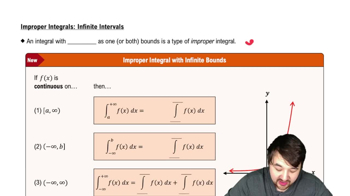
Improper Integrals: Infinite Intervals

Behavior of the Natural Logarithm Function near 1

The natural logarithm ln(x) approaches 0 as x approaches 1 from the right. Since the integral's denominator includes (ln x)^p, understanding how ln(x) behaves near 1 is crucial to assess whether the integral converges or diverges.
Recommended video:
05:18
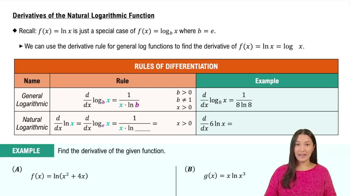
Derivative of the Natural Logarithmic Function

p-Test for Convergence of Integrals

The p-test helps determine convergence of integrals of the form ∫ (1 / t^p) dt near zero or infinity. By substituting t = ln(x), the integral can be analyzed using the p-test to find values of p for which the integral converges.
Recommended video:
07:51
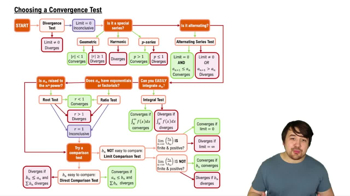
Choosing a Convergence Test