Ch. 7 - Transcendental Functions
Hass - Thomas' Calculus 15th Edition
Hass15th EditionThomas' CalculusISBN: 9780137616077Not the one you use?Change textbook
Chapter 7, Problem 7.1.59

Use the results of Exercise 55 to show that the functions in Exercises 56–60 have inverses over their domains. Find a formula for df⁻¹/dx using Theorem 1.
f(x) = (1 − x)³

Verified step by step guidance
1
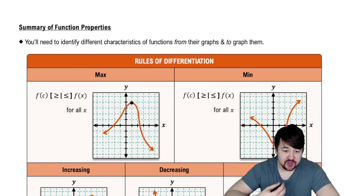
First, recall that to show a function has an inverse over its domain, it must be one-to-one (injective) and continuous on that domain. For the function \(f(x) = (1 - x)^3\), observe that it is a cubic function shifted and reflected, which is strictly monotonic (either strictly increasing or decreasing) over all real numbers, so it is one-to-one over its entire domain.
Next, find the derivative of \(f(x)\) with respect to \(x\). Using the chain rule, we have \(f'(x) = 3(1 - x)^2 \cdot (-1) = -3(1 - x)^2\).
According to Theorem 1 (the formula for the derivative of the inverse function), if \(y = f(x)\) has an inverse \(f^{-1}\), then the derivative of the inverse function at \(y\) is given by \(\frac{d}{dy} f^{-1}(y) = \frac{1}{f'(f^{-1}(y))}\).
To find a formula for \(\frac{d}{dx} f^{-1}(x)\), replace \(y\) by \(x\) in the formula above, so \(\frac{d}{dx} f^{-1}(x) = \frac{1}{f'(f^{-1}(x))}\). This means you need to express the derivative of \(f\) evaluated at \(f^{-1}(x)\).
Finally, substitute the expression for \(f'(x)\) into the formula: \(\frac{d}{dx} f^{-1}(x) = \frac{1}{-3(1 - f^{-1}(x))^2}\). This gives the derivative of the inverse function in terms of \(f^{-1}(x)\).

Verified video answer for a similar problem:

This video solution was recommended by our tutors as helpful for the problem above.
Video duration:
3m
Was this helpful?

Key Concepts

Here are the essential concepts you must grasp in order to answer the question correctly.

Invertibility of Functions

A function is invertible on a domain if it is one-to-one (injective) and onto (surjective) on that domain. This means each output corresponds to exactly one input, allowing the definition of an inverse function. For continuous functions, monotonicity (strictly increasing or decreasing) often guarantees invertibility.
Recommended video:
06:21
Properties of Functions

Derivative of the Inverse Function

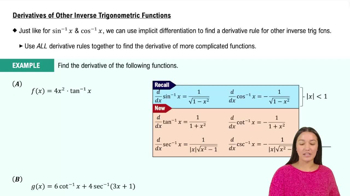
The derivative of the inverse function at a point can be found using the formula (df⁻¹/dx)(y) = 1 / (df/dx)(f⁻¹(y)), provided the original function's derivative is nonzero at that point. This relationship comes from the chain rule and allows computation of the inverse's derivative without explicitly finding the inverse.
Recommended video:
06:35
Derivatives of Other Inverse Trigonometric Functions

Theorem 1 (Inverse Function Theorem)

The Inverse Function Theorem states that if a function is differentiable and its derivative is nonzero at a point, then the function is locally invertible around that point, and the inverse function is differentiable there. This theorem justifies using the derivative formula for the inverse function.
Recommended video:
06:11
Fundamental Theorem of Calculus Part 1