
Textbook Question
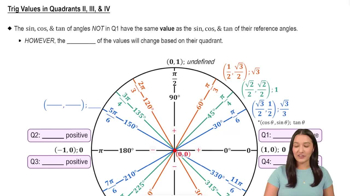
Use reference triangles in an appropriate quadrant to find the angles in Exercises 1–8.
7. c. arcsec(-2)

 Verified step by step guidance
 4:03
4:03
 5:30 4:03
Use reference triangles in an appropriate quadrant to find the angles in Exercises 1–8.
7. c. arcsec(-2)
In Exercises 1–4, show that each function y=f(x) is a solution of the accompanying differential equation.
1. 2y' + 3y = e^(-x)
c. y = e^(-x) + Ce^(-(3/2)x)
6. Which of the following functions grow faster than ln(x) as x→∞? Which grow at the same rate as ln(x)? Which grow slower?
c. 1/√x
5. Which of the following functions grow faster than ln(x) as x→∞? Which grow at the same rate as ln(x)? Which grow slower?
c. ln(√x)
In Exercises 1–4, solve for t.
1. c. e^((ln 0.2)t) = 0.4
2. Which of the following functions grow faster than e^x as x→∞? Which grow at the same rate as e^x? Which grow slower?
c. √(1+x^4)