Ch. 7 - Transcendental Functions
Hass - Thomas' Calculus 15th Edition
Hass15th EditionThomas' CalculusISBN: 9780137616077Not the one you use?Change textbook
Chapter 7, Problem 7.5.9

Use l’Hôpital’s rule to find the limits in Exercises 7–52.


9. lim (t → -3) (t³ - 4t + 15) / (t² - t - 12)

Verified step by step guidance
1
First, identify the limit expression: \(\lim_{t \to -3} \frac{t^{3} - 4t + 15}{t^{2} - t - 12}\).
Evaluate the numerator and denominator separately at \(t = -3\) to check if the limit is an indeterminate form. Calculate \((-3)^{3} - 4(-3) + 15\) and \((-3)^{2} - (-3) - 12\).
If both numerator and denominator evaluate to 0, then the limit is of the form \(\frac{0}{0}\), and l’Hôpital’s Rule can be applied.
Apply l’Hôpital’s Rule by differentiating the numerator and denominator separately with respect to \(t\): find \(\frac{d}{dt}(t^{3} - 4t + 15)\) and \(\frac{d}{dt}(t^{2} - t - 12)\).
After differentiation, substitute \(t = -3\) into the new expression \(\frac{\frac{d}{dt}(\text{numerator})}{\frac{d}{dt}(\text{denominator})}\) to find the limit.

Verified video answer for a similar problem:

This video solution was recommended by our tutors as helpful for the problem above.
Video duration:
2m
Was this helpful?

Key Concepts

Here are the essential concepts you must grasp in order to answer the question correctly.

Limits and Indeterminate Forms

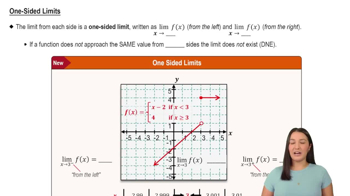
Limits describe the behavior of a function as the input approaches a particular value. When direct substitution results in an indeterminate form like 0/0 or ∞/∞, special techniques such as l’Hôpital’s rule are needed to evaluate the limit.
Recommended video:
05:50
One-Sided Limits

l’Hôpital’s Rule

l’Hôpital’s rule provides a method to evaluate limits that yield indeterminate forms by differentiating the numerator and denominator separately and then taking the limit of their quotient. It applies only when the original limit results in 0/0 or ∞/∞.
Recommended video:

Differentiation of Polynomial Functions

Differentiation involves finding the derivative of a function, which represents its rate of change. For polynomials, derivatives are found by applying the power rule term-by-term, which is essential when using l’Hôpital’s rule to differentiate numerator and denominator.
Recommended video:
07:00
Taylor Polynomials