Ch. 7 - Transcendental Functions
Hass - Thomas' Calculus 15th Edition
Hass15th EditionThomas' CalculusISBN: 9780137616077Not the one you use?Change textbook
Chapter 7, Problem 7.5.41

Use l’Hôpital’s rule to find the limits in Exercises 7–52.
41. lim (x → 0⁺) (ln x)² / ln(sin x)

Verified step by step guidance
1
First, identify the form of the limit as \( x \to 0^+ \) for the expression \( \frac{(\ln x)^2}{\ln(\sin x)} \). Substitute values close to 0 from the right to see if it results in an indeterminate form like \( \frac{0}{0} \) or \( \frac{\infty}{\infty} \).
Rewrite the limit to understand the behavior of numerator and denominator separately: \( (\ln x)^2 \) tends to \( \infty \) negatively squared (so tends to \( +\infty \)), and \( \ln(\sin x) \) as \( x \to 0^+ \) tends to \( \ln(0) = -\infty \). So the limit is of the form \( \frac{\infty}{-\infty} \), which is an indeterminate form suitable for l’Hôpital’s Rule.
Apply l’Hôpital’s Rule by differentiating the numerator and denominator separately with respect to \( x \): - Derivative of numerator: \( \frac{d}{dx} (\ln x)^2 = 2 \ln x \cdot \frac{1}{x} = \frac{2 \ln x}{x} \) - Derivative of denominator: \( \frac{d}{dx} \ln(\sin x) = \frac{1}{\sin x} \cdot \cos x = \cot x \)
Rewrite the limit using these derivatives: \[ \lim_{x \to 0^+} \frac{\frac{2 \ln x}{x}}{\cot x} = \lim_{x \to 0^+} \frac{2 \ln x}{x \cot x} \] Simplify the expression inside the limit if possible, for example by expressing \( \cot x = \frac{\cos x}{\sin x} \).
Evaluate the new limit by analyzing the behavior of each component as \( x \to 0^+ \). If the limit is still indeterminate, consider applying l’Hôpital’s Rule again or use series expansions to find the limit.

Verified video answer for a similar problem:

This video solution was recommended by our tutors as helpful for the problem above.
Video duration:
12m
Was this helpful?

Key Concepts

Here are the essential concepts you must grasp in order to answer the question correctly.

l’Hôpital’s Rule

l’Hôpital’s Rule is a method for evaluating limits that result in indeterminate forms like 0/0 or ∞/∞. It states that the limit of a ratio of functions can be found by taking the limit of the ratio of their derivatives, provided certain conditions are met.
Recommended video:

Behavior of Logarithmic Functions Near Zero

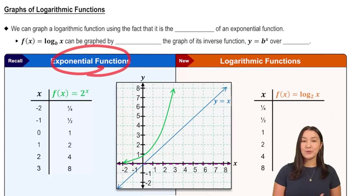
Understanding how logarithmic functions behave as their arguments approach zero is crucial. For example, ln(x) approaches negative infinity as x approaches 0 from the right, which affects the limit's form and helps determine if l’Hôpital’s Rule applies.
Recommended video:
5:26
Graphs of Logarithmic Functions

Limit of Trigonometric Functions Near Zero

Knowing the behavior of trigonometric functions like sin(x) near zero is essential. Since sin(x) ~ x for small x, ln(sin x) behaves like ln(x), which influences the limit and helps simplify the expression before applying l’Hôpital’s Rule.
Recommended video:
6:04
Introduction to Trigonometric Functions