Ch. 7 - Transcendental Functions
Hass - Thomas' Calculus 15th Edition
Hass15th EditionThomas' CalculusISBN: 9780137616077Not the one you use?Change textbook
Chapter 7, Problem 7.5.69

Theory and Applications
L’Hôpital’s Rule does not help with the limits in Exercises 69–76. 
Try it—you just keep on cycling. Find the limits some other way.
69. lim (x → ∞) (√(9x + 1)) / (√(x + 1))

Verified step by step guidance
1
Identify the limit expression: \(\lim_{x \to \infty} \frac{\sqrt{9x + 1}}{\sqrt{x + 1}}\).
Since both numerator and denominator involve square roots of expressions that grow without bound as \(x \to \infty\), try to simplify the expression by factoring out \(x\) inside the square roots.
Rewrite the numerator and denominator as \(\sqrt{x \left(9 + \frac{1}{x}\right)}\) and \(\sqrt{x \left(1 + \frac{1}{x}\right)}\) respectively.
Use the property of square roots to separate the factors: \(\frac{\sqrt{x} \sqrt{9 + \frac{1}{x}}}{\sqrt{x} \sqrt{1 + \frac{1}{x}}}\).
Cancel \(\sqrt{x}\) from numerator and denominator, then evaluate the limit of the remaining expression \(\frac{\sqrt{9 + \frac{1}{x}}}{\sqrt{1 + \frac{1}{x}}}\) as \(x \to \infty\) by substituting \(\frac{1}{x} \to 0\).

Verified video answer for a similar problem:

This video solution was recommended by our tutors as helpful for the problem above.
Video duration:
2m
Was this helpful?

Key Concepts

Here are the essential concepts you must grasp in order to answer the question correctly.

Limits at Infinity

Limits at infinity describe the behavior of a function as the input grows without bound. Understanding how functions behave as x approaches infinity helps determine the end behavior and whether the limit converges to a finite value, infinity, or does not exist.
Recommended video:
03:07
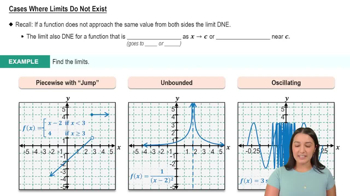
Cases Where Limits Do Not Exist

Simplifying Expressions Involving Radicals

When dealing with limits involving square roots, it is often helpful to factor and simplify the expression inside the radicals. This can involve dividing numerator and denominator by the highest power of x to reveal dominant terms and simplify the limit evaluation.
Recommended video:
6:36
Simplifying Trig Expressions

L’Hôpital’s Rule and Its Limitations

L’Hôpital’s Rule is used to evaluate indeterminate forms like 0/0 or ∞/∞ by differentiating numerator and denominator. However, it may fail or cause cyclic behavior if repeated application does not resolve the indeterminate form, requiring alternative methods such as algebraic simplification.
Recommended video:
05:50
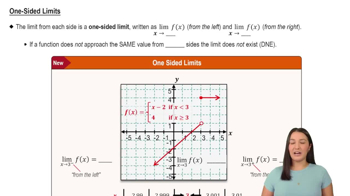
One-Sided Limits