
Ch. 7 - Transcendental Functions
Hass - Thomas' Calculus 15th Edition
Hass15th EditionThomas' CalculusISBN: 9780137616077Not the one you use?Change textbook
Chapter 7, Problem 7.1.47c

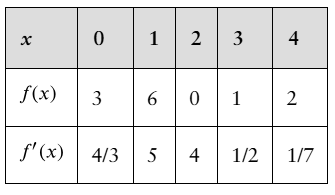
Suppose that the function f and its derivative with respect to x have the following values at x=0, 1, 2, 3, and 4.
Assuming the inverse function f^(-1) is differentiable, find the slope of f^(-1)(x) at
c. x=3
Table showing values of x, f(x), and f prime of x at points 0 to 4, used to find the slope of the inverse function at x=3.

Verified step by step guidance
1
Identify the value of \(c\) for which you need to find the slope of the inverse function \(f^{-1}(x)\). Here, \(c = 3\).
Recall the formula for the derivative of the inverse function: \(\left(f^{-1}\right)'(c) = \frac{1}{f'(f^{-1}(c))}\).
Find \(f^{-1}(3)\) by looking for the \(x\) value such that \(f(x) = 3\). From the table, \(f(0) = 3\), so \(f^{-1}(3) = 0\).
Use the value of \(f^{-1}(3)\) to find \(f'(f^{-1}(3)) = f'(0)\). From the table, \(f'(0) = \frac{4}{3}\).
Calculate the slope of the inverse function at \(x=3\) using the formula: \(\left(f^{-1}\right)'(3) = \frac{1}{f'(0)} = \frac{1}{\frac{4}{3}}\).

Verified video answer for a similar problem:

This video solution was recommended by our tutors as helpful for the problem above.
Video duration:
3m
Was this helpful?

Key Concepts

Here are the essential concepts you must grasp in order to answer the question correctly.

Inverse Function and Its Differentiability

An inverse function f^(-1) reverses the effect of the original function f, such that f(f^(-1)(x)) = x. For the inverse to be differentiable at a point, the original function must be continuous and have a non-zero derivative at the corresponding point. This ensures the inverse function's slope exists and can be calculated.
Recommended video:
06:35
Derivatives of Other Inverse Trigonometric Functions

Derivative of the Inverse Function

The derivative of the inverse function at a point x = c is given by (f^(-1))'(c) = 1 / f'(f^(-1)(c)). This formula relates the slope of the inverse function to the slope of the original function at the corresponding point. It requires finding the input value where f(x) = c and then using the derivative of f at that input.
Recommended video:
06:35
Derivatives of Other Inverse Trigonometric Functions

Using Tabulated Values to Find the Slope

Given a table of values for x, f(x), and f'(x), you can find the slope of the inverse function at x = c by first locating the x-value where f(x) = c. Then, use the corresponding f'(x) value to compute the inverse slope using the formula. This approach is practical when explicit functions are not provided.
Recommended video:
04:09
Understanding Slope Fields Example 2