Ch. 7 - Transcendental Functions
Hass - Thomas' Calculus 15th Edition
Hass15th EditionThomas' CalculusISBN: 9780137616077Not the one you use?Change textbook
Chapter 7, Problem 7.4.12

Solve the differential equation in Exercises 9–22.
12. (dy/dx) = 3x²e^(-y)

Verified step by step guidance
1
Rewrite the given differential equation \( \frac{dy}{dx} = 3x^{2} e^{-y} \) to separate the variables \( y \) and \( x \). Multiply both sides by \( e^{y} \) and multiply both sides by \( dx \) to get \( e^{y} dy = 3x^{2} dx \).
Integrate both sides separately: integrate \( e^{y} \) with respect to \( y \) and integrate \( 3x^{2} \) with respect to \( x \). This gives \( \int e^{y} dy = \int 3x^{2} dx \).
Compute the integrals: the integral of \( e^{y} \) with respect to \( y \) is \( e^{y} \), and the integral of \( 3x^{2} \) with respect to \( x \) is \( x^{3} + C \), where \( C \) is the constant of integration.
Write the implicit solution as \( e^{y} = x^{3} + C \).
If desired, solve explicitly for \( y \) by taking the natural logarithm of both sides: \( y = \ln(x^{3} + C) \), noting the domain restrictions for the logarithm.

Verified video answer for a similar problem:

This video solution was recommended by our tutors as helpful for the problem above.
Video duration:
2m
Was this helpful?

Key Concepts

Here are the essential concepts you must grasp in order to answer the question correctly.

Separable Differential Equations

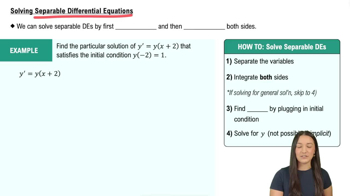
A separable differential equation can be written as a product of a function of x and a function of y, allowing variables to be separated on opposite sides of the equation. This enables integration with respect to each variable independently to find the solution.
Recommended video:
06:06
Solving Separable Differential Equations

Integration of Exponential Functions

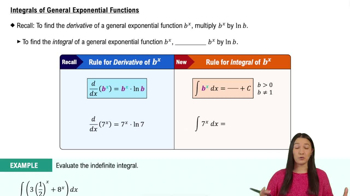
Integrating expressions involving exponential functions, such as e^(-y), requires understanding the chain rule in reverse. Recognizing that the integral of e^(-y) with respect to y is -e^(-y) plus a constant is essential for solving the equation.
Recommended video:
05:11
Integrals of General Exponential Functions

Implicit vs. Explicit Solutions

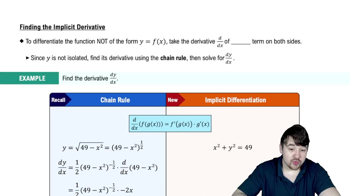
Solutions to differential equations can be implicit, where y is not isolated, or explicit, where y is expressed as a function of x. Understanding how to interpret and manipulate implicit solutions is important when the equation cannot be easily solved for y.
Recommended video:
05:14
Finding The Implicit Derivative