Ch. 7 - Transcendental Functions
Hass - Thomas' Calculus 15th Edition
Hass15th EditionThomas' CalculusISBN: 9780137616077Not the one you use?Change textbook
Chapter 7, Problem 7.5.63

Indeterminate Powers and Products
Find the limits in Exercises 53–68.
63. lim (x → ∞) ((x + 2)/(x - 1))^x

Verified step by step guidance
1
Identify the limit expression: \(\lim_{x \to \infty} \left( \frac{x + 2}{x - 1} \right)^x\).
Rewrite the base inside the parentheses to express it in a form that approaches 1 as \(x\) approaches infinity. For example, write \(\frac{x + 2}{x - 1} = \frac{x - 1 + 3}{x - 1} = 1 + \frac{3}{x - 1}\).
Recognize that the limit has the indeterminate form \(1^\infty\), which suggests using the exponential and logarithm transformation: rewrite the limit as \(\lim_{x \to \infty} e^{x \ln \left(1 + \frac{3}{x - 1} \right)}\).
Focus on evaluating the exponent limit: \(\lim_{x \to \infty} x \ln \left(1 + \frac{3}{x - 1} \right)\). Use the fact that \(\ln(1 + y) \approx y\) for small \(y\) to simplify the expression inside the limit.
Calculate the simplified limit of the exponent, then substitute back into the exponential function to find the overall limit.

Verified video answer for a similar problem:

This video solution was recommended by our tutors as helpful for the problem above.
Video duration:
5m
Was this helpful?

Key Concepts

Here are the essential concepts you must grasp in order to answer the question correctly.

Limits at Infinity

Limits at infinity describe the behavior of a function as the input variable grows without bound. Understanding how expressions behave as x approaches infinity helps determine the end behavior of functions, which is essential for evaluating limits like ((x + 2)/(x - 1))^x as x → ∞.
Recommended video:
03:07
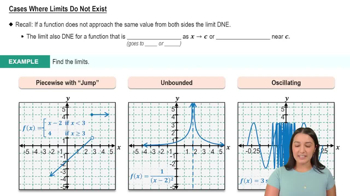
Cases Where Limits Do Not Exist

Indeterminate Forms

Indeterminate forms occur when a limit expression does not directly yield a clear value, such as 1^∞, 0/0, or ∞/∞. Recognizing these forms is crucial because they require special techniques, like logarithms or L'Hôpital's Rule, to resolve the limit properly.
Recommended video:
6:20
Circles in General Form

Exponential Limits and Logarithmic Transformation

When limits involve expressions raised to variable powers, rewriting the expression using logarithms can simplify evaluation. By setting y = f(x)^g(x), taking the natural log, and then applying limit laws, one can find the limit of y by exponentiating the limit of the logarithm.
Recommended video:
5:25
Intro to Transformations