Ch. 7 - Transcendental Functions
Hass - Thomas' Calculus 15th Edition
Hass15th EditionThomas' CalculusISBN: 9780137616077Not the one you use?Change textbook
Chapter 7, Problem 7.4.5

In Exercises 5–8, show that each function is a solution of the given initial value problem.
5. Differential Equation: 2y + y' = 4x + 2
Initial condition: y(-1) = e² - 2
Solution candidate: y = e^(-2x) + 2x

Verified step by step guidance
1
Identify the given differential equation: \(2y + y' = 4x + 2\) and the initial condition \(y(-1) = e^{2} - 2\).
Calculate the derivative of the candidate solution \(y = e^{-2x} + 2x\). Use the chain rule for the exponential term: \(y' = \frac{d}{dx}(e^{-2x}) + \frac{d}{dx}(2x) = -2e^{-2x} + 2\).
Substitute the candidate solution \(y\) and its derivative \(y'\) into the left side of the differential equation: \(2y + y' = 2(e^{-2x} + 2x) + (-2e^{-2x} + 2)\).
Simplify the expression from the substitution to verify if it equals the right side of the differential equation \(4x + 2\). This confirms whether the candidate function satisfies the differential equation.
Check the initial condition by substituting \(x = -1\) into the candidate solution \(y = e^{-2(-1)} + 2(-1)\) and verify if it equals \(e^{2} - 2\). This confirms the solution meets the initial value condition.

Verified video answer for a similar problem:

This video solution was recommended by our tutors as helpful for the problem above.
Video duration:
3m
Was this helpful?

Key Concepts

Here are the essential concepts you must grasp in order to answer the question correctly.

Initial Value Problem (IVP)

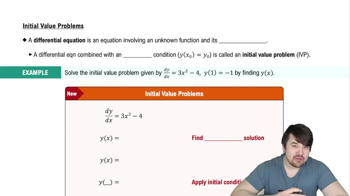
An initial value problem consists of a differential equation paired with a specific condition that the solution must satisfy at a given point. This condition, called the initial condition, ensures a unique solution by specifying the value of the function at a particular input, such as y(-1) = e² - 2.
Recommended video:
05:03
Initial Value Problems

Verification of a Solution to a Differential Equation

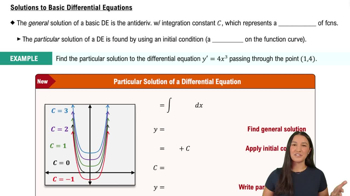
To verify a candidate solution, substitute it and its derivative into the differential equation to check if the equation holds true for all x in the domain. This process confirms whether the proposed function satisfies the relationship defined by the differential equation.
Recommended video:
04:00
Solutions to Basic Differential Equations

Differentiation of Exponential and Polynomial Functions

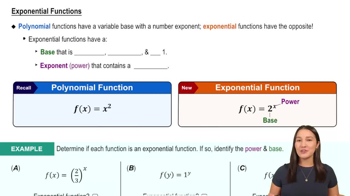
Differentiation rules for exponential functions like e^(-2x) and polynomial terms such as 2x are essential to find y'. The derivative of e^(-2x) is -2e^(-2x), and the derivative of 2x is 2, which are used to substitute into the differential equation for verification.
Recommended video:
6:13
Exponential Functions