Ch. 7 - Transcendental Functions
Hass - Thomas' Calculus 15th Edition
Hass15th EditionThomas' CalculusISBN: 9780137616077Not the one you use?Change textbook
Chapter 7, Problem 7.4.3

In Exercises 1–4, show that each function y=f(x) is a solution of the accompanying differential equation.
3. y = 1/x ∫(from 1 to x) e^t/t dt, x²y' + xy = e^x

Verified step by step guidance
1
Identify the given function: \(y = \frac{1}{x} \int_{1}^{x} \frac{e^{t}}{t} \, dt\).
Apply the product rule and the Fundamental Theorem of Calculus to find \(y'\). Since \(y\) is a quotient involving an integral, write \(y\) as \(y = \frac{1}{x} \cdot F(x)\) where \(F(x) = \int_{1}^{x} \frac{e^{t}}{t} \, dt\).
Differentiate \(y\) using the quotient rule or product rule: \(y' = \frac{d}{dx} \left( \frac{1}{x} F(x) \right) = -\frac{1}{x^{2}} F(x) + \frac{1}{x} F'(x)\).
Use the Fundamental Theorem of Calculus to find \(F'(x) = \frac{e^{x}}{x}\), then substitute back into the expression for \(y'\).
Substitute \(y\) and \(y'\) into the differential equation \(x^{2} y' + x y\) and simplify to verify that it equals \(e^{x}\).

Verified video answer for a similar problem:

This video solution was recommended by our tutors as helpful for the problem above.
Video duration:
6m
Was this helpful?

Key Concepts

Here are the essential concepts you must grasp in order to answer the question correctly.

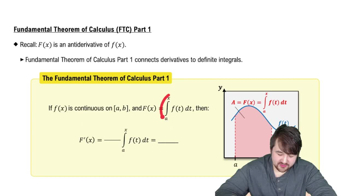
Fundamental Theorem of Calculus

This theorem connects differentiation and integration, stating that if a function is defined as an integral with a variable upper limit, its derivative is the integrand evaluated at that limit. It allows us to differentiate functions defined by integrals, which is essential for finding y' in the given problem.
Recommended video:
06:11
Fundamental Theorem of Calculus Part 1

Differentiation of Functions Defined by Integrals

When a function is given as an integral with variable limits, its derivative involves applying the Fundamental Theorem of Calculus and the product or chain rule if multiplied by other functions. Understanding this helps compute y' for y = (1/x) ∫(1 to x) (e^t / t) dt.
Recommended video:
04:22
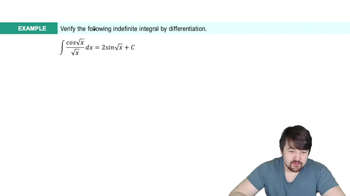
Integrals Resulting in Basic Trig Functions Example 1

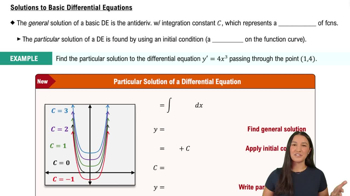
Verification of Solutions to Differential Equations

To verify a function solves a differential equation, substitute the function and its derivative into the equation and simplify. If both sides match, the function is a solution. This process confirms that y and y' satisfy x²y' + xy = e^x.
Recommended video:
04:00
Solutions to Basic Differential Equations