Ch. 7 - Transcendental Functions
Hass - Thomas' Calculus 15th Edition
Hass15th EditionThomas' CalculusISBN: 9780137616077Not the one you use?Change textbook
Chapter 7, Problem 7.6.81

Evaluate the integrals in Exercises 77–90.
81. ∫dy/(y²-2y+5)

Verified step by step guidance
1
Start by rewriting the quadratic expression in the denominator to a completed square form. The denominator is \(y^2 - 2y + 5\). Complete the square by expressing it as \((y - a)^2 + b\) for some constants \(a\) and \(b\).
Recall that to complete the square for \(y^2 - 2y + 5\), you take half of the coefficient of \(y\), which is \(-2\), divide by 2 to get \(-1\), then square it to get \(1\). So rewrite the denominator as \((y - 1)^2 + (5 - 1)\).
Simplify the expression inside the parentheses to get \((y - 1)^2 + 4\). Now the integral becomes \(\int \frac{dy}{(y - 1)^2 + 4}\).
Recognize that this integral matches the standard form \(\int \frac{dx}{x^2 + a^2} = \frac{1}{a} \arctan\left(\frac{x}{a}\right) + C\). Here, \(x = y - 1\) and \(a^2 = 4\), so \(a = 2\).
Make the substitution \(u = y - 1\), so \(du = dy\). Rewrite the integral in terms of \(u\) and apply the formula to express the integral in terms of the arctangent function.

Verified video answer for a similar problem:

This video solution was recommended by our tutors as helpful for the problem above.
Video duration:
1m
Was this helpful?

Key Concepts

Here are the essential concepts you must grasp in order to answer the question correctly.

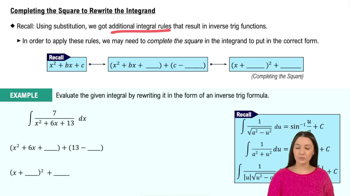
Completing the Square

Completing the square is a technique used to rewrite quadratic expressions in the form (y - h)² + k. This simplifies the integral by transforming the denominator into a recognizable form, often enabling the use of standard integral formulas involving inverse trigonometric functions.
Recommended video:
05:22
Completing the Square to Rewrite the Integrand

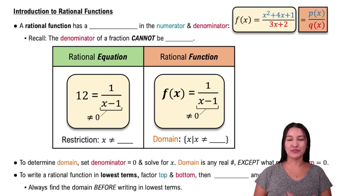
Integration of Rational Functions

Integrating rational functions involves expressing the integrand in a simpler form, often by partial fraction decomposition or algebraic manipulation. For quadratics that do not factor easily, rewriting the denominator helps apply known integral formulas.
Recommended video:
6:04
Intro to Rational Functions

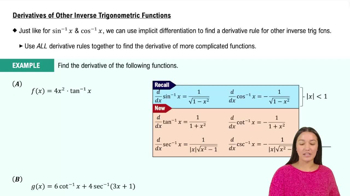
Inverse Trigonometric Integrals

Certain integrals involving expressions like 1/(x² + a²) correspond to inverse trigonometric functions such as arctangent. Recognizing these forms allows direct application of formulas like ∫dx/(x² + a²) = (1/a) arctan(x/a) + C.
Recommended video:
06:35
Derivatives of Other Inverse Trigonometric Functions