Ch. 7 - Transcendental Functions
Hass - Thomas' Calculus 15th Edition
Hass15th EditionThomas' CalculusISBN: 9780137616077Not the one you use?Change textbook
Chapter 7, Problem 7.PE.52

Evaluate the integrals in Exercises 31–78.
52. ∫(from 1 to 32)(1/5x) dx

Verified step by step guidance
1
Identify the integral to be evaluated: \(\int_{1}^{32} \frac{1}{5x} \, dx\).
Rewrite the integrand by factoring out constants: \(\frac{1}{5} \int_{1}^{32} \frac{1}{x} \, dx\).
Recall the integral formula for \(\int \frac{1}{x} \, dx = \ln|x| + C\).
Apply the definite integral evaluation: \(\frac{1}{5} \left[ \ln|x| \right]_{1}^{32} = \frac{1}{5} (\ln 32 - \ln 1)\).
Simplify the expression using properties of logarithms, noting that \(\ln 1 = 0\), so the result is \(\frac{1}{5} \ln 32\).

Verified video answer for a similar problem:

This video solution was recommended by our tutors as helpful for the problem above.
Video duration:
1m
Was this helpful?

Key Concepts

Here are the essential concepts you must grasp in order to answer the question correctly.

Definite Integral

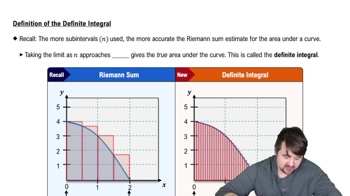
A definite integral calculates the net area under a curve between two specific points on the x-axis. It is represented as ∫ from a to b of f(x) dx, where a and b are the limits of integration. The result is a number representing the accumulated value of the function over that interval.
Recommended video:
05:43
Definition of the Definite Integral

Integral of a Power Function

The integral of x raised to a power n (where n ≠ -1) is found using the formula ∫ x^n dx = (x^(n+1)) / (n+1) + C. This rule helps in integrating functions like x raised to fractional or negative powers, which is essential for solving integrals involving terms like x^(-1).
Recommended video:
07:32
Representing Functions as Power Series

Properties of Constants in Integration

When integrating, constants can be factored out of the integral to simplify calculations. For example, ∫ c * f(x) dx = c * ∫ f(x) dx, where c is a constant. This property allows easier handling of integrals with constant coefficients, such as 1/5 in the given integral.
Recommended video:
06:21
Properties of Functions