Ch. 7 - Transcendental Functions
Hass - Thomas' Calculus 15th Edition
Hass15th EditionThomas' CalculusISBN: 9780137616077Not the one you use?Change textbook
Chapter 7, Problem 7.PE.45

Evaluate the integrals in Exercises 31–78.
45. ∫(ln x)^(-3)/x dx

Verified step by step guidance
1
Identify the integral to solve: \(\int \frac{(\ln x)^{-3}}{x} \, dx\).
Recognize that the integral involves a composite function with \(\ln x\) inside and a factor of \(\frac{1}{x}\) outside, which suggests using substitution.
Let \(u = \ln x\). Then, compute the differential: \(du = \frac{1}{x} \, dx\), which means \(dx = x \, du\) but since \(du = \frac{1}{x} dx\), we can rewrite \(\frac{1}{x} dx\) as \(du\).
Rewrite the integral in terms of \(u\): \(\int u^{-3} \, du\).
Integrate \(u^{-3}\) using the power rule for integrals: \(\int u^{n} \, du = \frac{u^{n+1}}{n+1} + C\) for \(n \neq -1\). Here, \(n = -3\), so the integral becomes \(\frac{u^{-2}}{-2} + C\).

Verified video answer for a similar problem:

This video solution was recommended by our tutors as helpful for the problem above.
Video duration:
1m
Was this helpful?

Key Concepts

Here are the essential concepts you must grasp in order to answer the question correctly.

Integration by Substitution

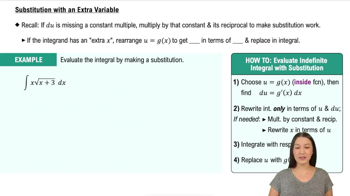
Integration by substitution is a method used to simplify integrals by changing variables. It involves identifying a part of the integrand as a new variable, differentiating it, and rewriting the integral in terms of this variable to make it easier to solve.
Recommended video:
04:27
Substitution With an Extra Variable

Properties of Logarithmic Functions

Understanding the natural logarithm function, ln(x), is essential, including its domain (x > 0) and derivative (1/x). Recognizing how powers of ln(x) behave helps in manipulating and integrating expressions involving logarithms.
Recommended video:
06:21
Properties of Functions

Integration of Power Functions

Integrating functions of the form u^n, where n is a real number, follows the power rule for integration. This rule states that ∫u^n du = u^(n+1)/(n+1) + C, provided n ≠ -1, which is crucial when integrating expressions like (ln x)^(-3).
Recommended video:
07:32
Representing Functions as Power Series