Ch. 7 - Transcendental Functions
Hass - Thomas' Calculus 15th Edition
Hass15th EditionThomas' CalculusISBN: 9780137616077Not the one you use?Change textbook
Chapter 7, Problem 7.1.33

Each of Exercises 25–36 gives a formula for a function y=f(x). In each case, find f^(-1)(x) and identify the domain and range of f^(-1). As a check, show that f(f^(-1)(x))=f^(-1)(f(x))=x.
f(x) = x² − 2x, x ≤ 1

Verified step by step guidance
1
Start by writing the function explicitly: \(f(x) = x^{2} - 2x\) with the domain \(x \leq 1\).
To find the inverse function \(f^{-1}(x)\), first replace \(f(x)\) with \(y\): \(y = x^{2} - 2x\).
Next, solve the equation \(y = x^{2} - 2x\) for \(x\) in terms of \(y\). Rearrange it as a quadratic equation: \(x^{2} - 2x - y = 0\).
Use the quadratic formula to solve for \(x\): \(x = \frac{2 \pm \sqrt{(-2)^{2} - 4 \cdot 1 \cdot (-y)}}{2 \cdot 1} = \frac{2 \pm \sqrt{4 + 4y}}{2} = 1 \pm \sqrt{1 + y}\).
Since the original domain is \(x \leq 1\), choose the branch of the solution that satisfies this domain (which will be \(x = 1 - \sqrt{1 + y}\)). Then express the inverse function as \(f^{-1}(x) = 1 - \sqrt{1 + x}\). Finally, determine the domain and range of \(f^{-1}\) by considering the range and domain of \(f\), respectively.

Verified video answer for a similar problem:

This video solution was recommended by our tutors as helpful for the problem above.
Video duration:
5m
Was this helpful?

Key Concepts

Here are the essential concepts you must grasp in order to answer the question correctly.

Inverse Functions

An inverse function reverses the effect of the original function, swapping inputs and outputs. For a function f(x), its inverse f⁻¹(x) satisfies f(f⁻¹(x)) = x and f⁻¹(f(x)) = x within their domains. Finding the inverse involves solving y = f(x) for x in terms of y.
Recommended video:
4:49
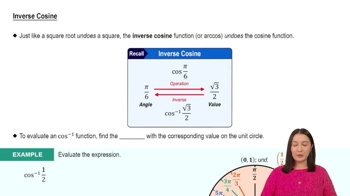
Inverse Cosine

Domain and Range Restrictions

To ensure a function has an inverse, it must be one-to-one, often requiring domain restrictions. The domain of f becomes the range of f⁻¹, and the range of f becomes the domain of f⁻¹. Identifying these sets is crucial for correctly defining and verifying the inverse.
Recommended video:
5:10
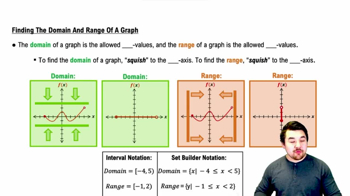
Finding the Domain and Range of a Graph

Verification of Inverse Functions

Verifying an inverse involves composing the function and its inverse in both orders: f(f⁻¹(x)) and f⁻¹(f(x)). Both compositions should simplify to x within the appropriate domains. This confirms the correctness of the inverse function and the domain-range assignments.
Recommended video:
4:49
Inverse Cosine