Ch. 7 - Transcendental Functions
Hass - Thomas' Calculus 15th Edition
Hass15th EditionThomas' CalculusISBN: 9780137616077Not the one you use?Change textbook
Chapter 7, Problem 7.7.82h

82. Use the definitions of the hyperbolic functions to find each of the following limits.
h. lim(x→0^-) coth x

Verified step by step guidance
1
Recall the definition of the hyperbolic cotangent function: \(\coth x = \frac{\cosh x}{\sinh x}\), where \(\cosh x = \frac{e^{x} + e^{-x}}{2}\) and \(\sinh x = \frac{e^{x} - e^{-x}}{2}\).
Express \(\coth x\) explicitly in terms of exponentials: \(\coth x = \frac{\frac{e^{x} + e^{-x}}{2}}{\frac{e^{x} - e^{-x}}{2}} = \frac{e^{x} + e^{-x}}{e^{x} - e^{-x}}\).
Analyze the behavior of the numerator and denominator as \(x\) approaches \(0\) from the left (i.e., \(x \to 0^-\)). Consider the series expansions or the values of \(e^{x}\) and \(e^{-x}\) near zero.
Since both numerator and denominator approach zero, consider simplifying the expression or using limits properties such as L'Hôpital's Rule if necessary.
Apply the limit \(\lim_{x \to 0^-} \coth x\) by substituting the expressions and evaluating the limit carefully, keeping in mind the sign of \(x\) approaching zero from the negative side.

Verified video answer for a similar problem:

This video solution was recommended by our tutors as helpful for the problem above.
Video duration:
3m
Was this helpful?

Key Concepts

Here are the essential concepts you must grasp in order to answer the question correctly.

Definition of Hyperbolic Cotangent (coth x)

The hyperbolic cotangent function, coth x, is defined as the ratio of the hyperbolic cosine to the hyperbolic sine: coth x = cosh x / sinh x. Understanding this definition is essential to analyze its behavior near specific points, such as x approaching zero.
Recommended video:
05:43
Definition of the Definite Integral

Behavior of Hyperbolic Sine and Cosine Near Zero

Near x = 0, sinh x behaves like x (since sinh x ≈ x for small x), and cosh x approaches 1. This approximation helps simplify the limit expressions involving hyperbolic functions and is crucial for evaluating limits as x approaches zero.
Recommended video:
03:53
Derivatives of Sine & Cosine

Limit from the Left-Hand Side (x → 0⁻)

When evaluating limits as x approaches zero from the left (x → 0⁻), it is important to consider the sign and behavior of the function values just less than zero. For coth x, since sinh x changes sign around zero, the left-hand limit may differ from the right-hand limit.
Recommended video:
05:50
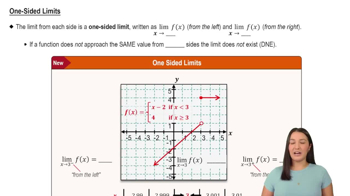
One-Sided Limits