Ch. 7 - Transcendental Functions
Hass - Thomas' Calculus 15th Edition
Hass15th EditionThomas' CalculusISBN: 9780137616077Not the one you use?Change textbook
Chapter 7, Problem 7.3.130

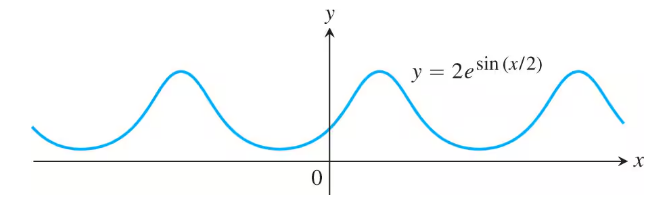
130. Where does the periodic function f(x) = 2e^(sin(x/2)) take on its extreme values, and what are these values?
Graph of the periodic function y = 2e^(sin(x/2)) showing smooth oscillations with labeled x and y axes.

Verified step by step guidance
1
Identify the function given: \(f(x) = 2e^{\sin(\frac{x}{2})}\), which is periodic due to the sine function inside the exponent.
To find the extreme values, compute the derivative \(f'(x)\) using the chain rule: \(f'(x) = 2e^{\sin(\frac{x}{2})} \cdot \cos(\frac{x}{2}) \cdot \frac{1}{2}\).
Set the derivative equal to zero to find critical points: \(f'(x) = 0 \Rightarrow 2e^{\sin(\frac{x}{2})} \cdot \cos(\frac{x}{2}) \cdot \frac{1}{2} = 0\). Since \(2e^{\sin(\frac{x}{2})} \neq 0\), this simplifies to \(\cos(\frac{x}{2}) = 0\).
Solve \(\cos(\frac{x}{2}) = 0\) for \(x\): \(\frac{x}{2} = \frac{\pi}{2} + k\pi\), where \(k\) is any integer, so \(x = \pi + 2k\pi\).
Evaluate \(f(x)\) at these critical points to find the extreme values: \(f(x) = 2e^{\sin(\frac{x}{2})}\), and since \(\sin(\frac{x}{2})\) oscillates between -1 and 1, the minimum and maximum values correspond to \(\sin(\frac{x}{2}) = -1\) and \(\sin(\frac{x}{2}) = 1\), respectively.

Verified video answer for a similar problem:

This video solution was recommended by our tutors as helpful for the problem above.
Video duration:
7m
Was this helpful?

Key Concepts

Here are the essential concepts you must grasp in order to answer the question correctly.

Periodic Functions

A periodic function repeats its values at regular intervals called periods. Understanding the period helps identify where the function's behavior repeats, which is essential for locating extreme values within one period and extending that knowledge to all periods.
Recommended video:
6:22
Graphs of Secant and Cosecant Functions

Extreme Values of a Function

Extreme values are points where a function reaches local maxima or minima. These occur where the derivative is zero or undefined, and the function changes direction. Finding these points involves differentiating the function and solving for critical points.
Recommended video:
06:37
Average Value of a Function

Chain Rule and Differentiation of Composite Functions

The function f(x) = 2e^(sin(x/2)) is a composite function involving an exponential and a trigonometric function. Differentiating it requires applying the chain rule, which handles the derivative of a function inside another function, crucial for finding critical points.
Recommended video:
03:58
The Chain Rule for 3+ Functions