Ch. 7 - Transcendental Functions
Hass - Thomas' Calculus 15th Edition
Hass15th EditionThomas' CalculusISBN: 9780137616077Not the one you use?Change textbook
Chapter 7, Problem 7.8.1e

1. Which of the following functions grow faster than e^x as x→∞? Which grow at the same rate as e^x? Which grow slower?
e. (3/2)^x

Verified step by step guidance
1
Recall that the growth rate of exponential functions as \(x \to \infty\) depends on the base of the exponent. The function \(e^x\) has base \(e \approx 2.718\).
Compare the base of the given function \((\frac{3}{2})^x\) with the base \(e\) of \(e^x\). Here, \(\frac{3}{2} = 1.5\) which is less than \(e\).
Since \(1.5 < e\), the function \((\frac{3}{2})^x\) grows slower than \(e^x\) as \(x \to \infty\).
To summarize, if the base of the exponential function is less than \(e\), it grows slower than \(e^x\); if it equals \(e\), it grows at the same rate; and if it is greater than \(e\), it grows faster.
Therefore, \((\frac{3}{2})^x\) grows slower than \(e^x\) as \(x\) approaches infinity.

Verified video answer for a similar problem:

This video solution was recommended by our tutors as helpful for the problem above.
Video duration:
4m
Was this helpful?

Key Concepts

Here are the essential concepts you must grasp in order to answer the question correctly.

Exponential Growth and Base Comparison

Exponential functions have the form a^x, where a > 0. The growth rate depends on the base a: if a > 1, the function grows exponentially. Comparing bases helps determine which function grows faster as x approaches infinity.
Recommended video:
09:29
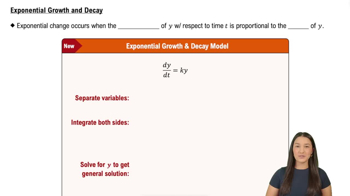
Exponential Growth & Decay

Limit Behavior as x Approaches Infinity

Analyzing the limit of the ratio of two functions as x→∞ reveals their relative growth rates. If the limit is zero, the numerator grows slower; if infinite, it grows faster; if finite and nonzero, they grow at the same rate.
Recommended video:
03:07
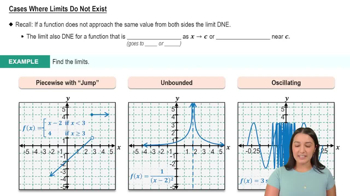
Cases Where Limits Do Not Exist

Growth Rate Comparison of Exponential Functions

For exponential functions e^x and a^x, growth rate depends on the base: e ≈ 2.718. If a < e, a^x grows slower than e^x; if a = e, they grow at the same rate; if a > e, a^x grows faster than e^x as x→∞.
Recommended video:
09:29
Exponential Growth & Decay