Ch. 7 - Transcendental Functions
Hass - Thomas' Calculus 15th Edition
Hass15th EditionThomas' CalculusISBN: 9780137616077Not the one you use?Change textbook
Chapter 7, Problem 7.8.1.f

1. Which of the following functions grow faster than e^x as x→∞? Which grow at the same rate as e^x? Which grow slower?
f. (e^x)/2

Verified step by step guidance
1
Recall that the function \(e^x\) is an exponential function with base \(e\), and its growth rate as \(x \to \infty\) is very fast compared to polynomial or logarithmic functions.
Analyze the given function \(f(x) = \frac{e^x}{2}\). This can be rewritten as \(f(x) = \frac{1}{2} e^x\).
Since \(f(x)\) is just \(e^x\) multiplied by a constant factor \(\frac{1}{2}\), the growth rate of \(f(x)\) as \(x \to \infty\) is the same as that of \(e^x\).
In general, multiplying an exponential function by a positive constant does not change its growth rate classification; it only scales the function vertically.
Therefore, \(f(x) = \frac{e^x}{2}\) grows at the same rate as \(e^x\) as \(x \to \infty\).

Verified video answer for a similar problem:

This video solution was recommended by our tutors as helpful for the problem above.
Video duration:
2m
Was this helpful?

Key Concepts

Here are the essential concepts you must grasp in order to answer the question correctly.

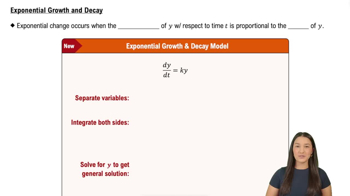
Exponential Growth

Exponential growth describes functions where the variable appears in the exponent, such as e^x. These functions increase rapidly as x approaches infinity, outpacing polynomial and logarithmic functions. Understanding the nature of e^x is essential for comparing growth rates.
Recommended video:
09:29
Exponential Growth & Decay

Growth Rate Comparison Using Limits

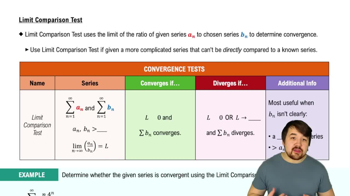
To compare growth rates of functions as x→∞, we use limits of their ratios. If the limit of f(x)/g(x) is zero, f grows slower; if it is a finite nonzero constant, they grow at the same rate; if infinite, f grows faster. This method helps classify functions by their relative growth.
Recommended video:
07:45
Limit Comparison Test

Constant Multipliers and Their Effect on Growth

Multiplying a function by a constant, like (e^x)/2, does not change its growth rate class. Constants scale the function's value but do not affect how fast it grows compared to other functions as x→∞. Recognizing this helps in identifying equivalent growth rates.
Recommended video:
09:29
Exponential Growth & Decay