
Ch. 6 - Applications of Definite Integrals
Hass - Thomas' Calculus 15th Edition
Hass15th EditionThomas' CalculusISBN: 9780137616077Not the one you use?Change textbook
Chapter 6, Problem 6.PE.13b

Volumes
Find the volume of the solid generated by revolving the region between the x-axis and curve y = x² ―2x about
b. the line y = ―1

Verified step by step guidance
1
First, identify the region bounded by the curve \(y = x^{2} - 2x\) and the x-axis. To do this, find the points where the curve intersects the x-axis by solving \(x^{2} - 2x = 0\).
Next, since the solid is generated by revolving the region about the line \(y = -1\), determine the radius of the typical disk or washer. The radius will be the vertical distance from the curve to the line \(y = -1\). Express this radius as \(R(x) = (y - (-1)) = (x^{2} - 2x + 1)\).
Because the region is bounded below by the x-axis (\(y=0\)), the inner radius of the washer is the distance from \(y=0\) to \(y=-1\), which is \(r = 1\). So, the volume element is a washer with outer radius \(R(x)\) and inner radius \(r\).
Set up the volume integral using the washer method: \(V = \pi \int_{a}^{b} \left[R(x)^{2} - r^{2}\right] \, dx\), where \(a\) and \(b\) are the x-values found in step 1.
Finally, expand the integrand, simplify, and prepare to integrate with respect to \(x\) over the interval \([a, b]\) to find the volume.

Verified video answer for a similar problem:

This video solution was recommended by our tutors as helpful for the problem above.
Video duration:
10m
Was this helpful?

Key Concepts

Here are the essential concepts you must grasp in order to answer the question correctly.

Volume of Solids of Revolution

This concept involves finding the volume of a 3D solid formed by rotating a 2D region around a line. The volume is typically calculated using integral methods such as the disk, washer, or shell method, depending on the axis of rotation and the shape of the region.
Recommended video:
04:48
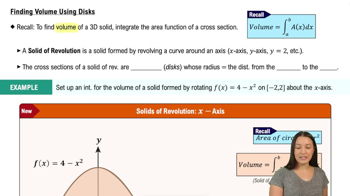
Finding Volume Using Disks

Washer Method

The washer method is used when the solid has a hollow center, created by revolving a region around a line that does not coincide with the axis of the curve. It involves subtracting the volume of the inner radius from the outer radius, integrating the difference of squared radii times π.
Recommended video:
07:33
Euler's Method

Adjusting for Axis of Rotation (Line y = -1)

When revolving around a line other than the x-axis or y-axis, distances (radii) must be measured relative to that line. For y = -1, the radius is the vertical distance between the curve and y = -1, requiring careful adjustment of the function values before applying the volume formula.
Recommended video:
06:30
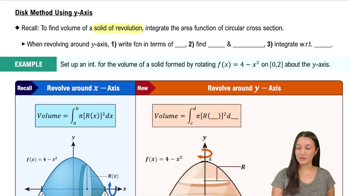
Disk Method Using y-Axis