Ch. 5 - Integrals
Hass - Thomas' Calculus 15th Edition
Hass15th EditionThomas' CalculusISBN: 9780137616077Not the one you use?Change textbook
Chapter 5, Problem 5.PE.47

Evaluating Definite Integrals


Evaluate the integrals in Exercises 47–68.


∫₋₁¹ (3x² - 4x + 7)dx

Verified step by step guidance
1
Identify the integral to evaluate: \(\int_{-1}^{1} (3x^{2} - 4x + 7) \, dx\).
Split the integral into the sum of integrals of each term: \(\int_{-1}^{1} 3x^{2} \, dx - \int_{-1}^{1} 4x \, dx + \int_{-1}^{1} 7 \, dx\).
Find the antiderivative of each term separately: For \$3x^{2}\(, the antiderivative is \(3 \cdot \frac{x^{3}}{3} = x^{3}\); for \)-4x\(, it is \(-4 \cdot \frac{x^{2}}{2} = -2x^{2}\); for \(7\), it is \)7x$.
Write the combined antiderivative function: \(F(x) = x^{3} - 2x^{2} + 7x\).
Evaluate \(F(x)\) at the upper limit \(x=1\) and the lower limit \(x=-1\), then subtract: \(F(1) - F(-1)\) to find the value of the definite integral.

Verified video answer for a similar problem:

This video solution was recommended by our tutors as helpful for the problem above.
Video duration:
4m
Was this helpful?

Key Concepts

Here are the essential concepts you must grasp in order to answer the question correctly.

Definite Integral

A definite integral calculates the net area under a curve between two specified limits. It is represented as ∫_a^b f(x) dx, where a and b are the lower and upper bounds. The result is a number that represents the accumulation of the function's values over the interval.
Recommended video:
05:43
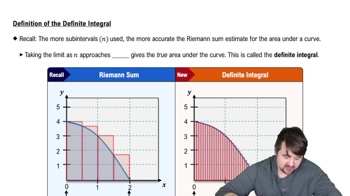
Definition of the Definite Integral

Fundamental Theorem of Calculus

This theorem links differentiation and integration, stating that if F is an antiderivative of f, then ∫_a^b f(x) dx = F(b) - F(a). It allows evaluation of definite integrals by finding antiderivatives instead of using limits of Riemann sums.
Recommended video:
06:11
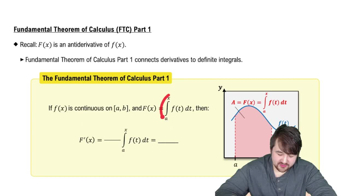
Fundamental Theorem of Calculus Part 1

Polynomial Integration

Integrating polynomials involves applying the power rule: ∫ x^n dx = (x^(n+1))/(n+1) + C for n ≠ -1. Each term of the polynomial is integrated separately, making it straightforward to find antiderivatives for functions like 3x² - 4x + 7.
Recommended video:
07:00
Taylor Polynomials