Ch. 5 - Integrals
Hass - Thomas' Calculus 15th Edition
Hass15th EditionThomas' CalculusISBN: 9780137616077Not the one you use?Change textbook
Chapter 5, Problem 5.PE.75

Differentiating Integrals


In Exercises 75–78, find dy/dx.
________
y = ∫₂ˣ √ 2 + cos³t dt

Verified step by step guidance
1
Identify the function y as a definite integral with a variable upper limit: \(y = \int_{2}^{x} \sqrt{2 + \cos^{3} t} \, dt\).
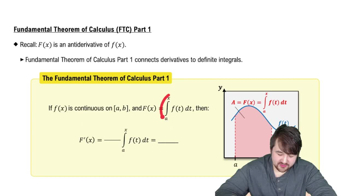
Recall the Fundamental Theorem of Calculus Part 1, which states that if \(y = \int_{a}^{x} f(t) \, dt\), then \(\frac{dy}{dx} = f(x)\), provided \(f\) is continuous.
Apply the theorem directly to the given integral, recognizing that the integrand is \(f(t) = \sqrt{2 + \cos^{3} t}\).
Write the derivative as \(\frac{dy}{dx} = \sqrt{2 + \cos^{3} x}\), substituting the upper limit \(x\) into the integrand.
No further simplification is necessary unless specified; this expression represents the derivative \(\frac{dy}{dx}\).

Verified video answer for a similar problem:

This video solution was recommended by our tutors as helpful for the problem above.
Video duration:
1m
Was this helpful?

Key Concepts

Here are the essential concepts you must grasp in order to answer the question correctly.

Fundamental Theorem of Calculus Part 1

This theorem connects differentiation and integration by stating that if y is defined as an integral with a variable upper limit, then dy/dx equals the integrand evaluated at that upper limit. It allows us to differentiate integrals with variable limits directly.
Recommended video:
06:11
Fundamental Theorem of Calculus Part 1

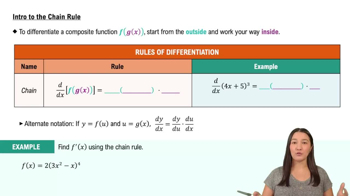
Chain Rule

When the upper limit of the integral is a function of x (not just x itself), the chain rule is used to differentiate the integral. It involves multiplying the derivative of the integral's upper limit by the integrand evaluated at that limit.
Recommended video:
05:02
Intro to the Chain Rule

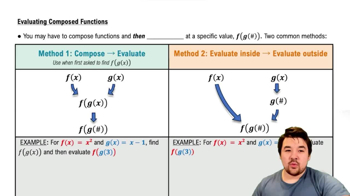
Integrand Function and Its Evaluation

Understanding the integrand, here √(2 + cos³t), is crucial because it must be evaluated at the upper limit of integration after differentiation. Recognizing how to substitute the variable limit into the integrand is key to finding dy/dx.
Recommended video:
4:26
Evaluating Composed Functions