Ch. 5 - Integrals
Hass - Thomas' Calculus 15th Edition
Hass15th EditionThomas' CalculusISBN: 9780137616077Not the one you use?Change textbook
Chapter 5, Problem 5.PE.11

Area
In Exercises 11–14, find the total area of the region between the graph of ƒ and the x-axis.
ƒ(x) = x² - 4x + 3, 0 ≤ x ≤ 3

Verified step by step guidance
1
Identify the function given: \(f(x) = x^{2} - 4x + 3\) and the interval \(0 \leq x \leq 3\) over which we want to find the total area between the graph and the x-axis.
Find the points where the graph intersects the x-axis by solving \(f(x) = 0\). This means solving the quadratic equation \(x^{2} - 4x + 3 = 0\).
Determine the sign of \(f(x)\) on each subinterval defined by the roots found in step 2 within the interval \([0,3]\). This helps to know where the graph is above or below the x-axis.
Set up the integral(s) for the total area. For regions where \(f(x)\) is positive, integrate \(f(x)\); for regions where \(f(x)\) is negative, integrate \(-f(x)\) to ensure the area is positive. The total area is the sum of these integrals.
Write the total area as the sum of definite integrals over the subintervals, for example: \(\int_{a}^{b} |f(x)| \, dx = \int_{a}^{c} f(x) \, dx - \int_{c}^{b} f(x) \, dx\) if \(f(x)\) changes sign at \(x=c\). Then, prepare to evaluate these integrals.

Verified video answer for a similar problem:

This video solution was recommended by our tutors as helpful for the problem above.
Video duration:
5m
Was this helpful?

Key Concepts

Here are the essential concepts you must grasp in order to answer the question correctly.

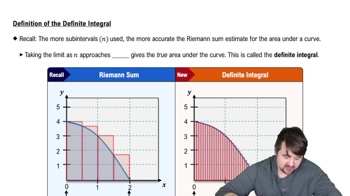
Definite Integral and Area Under a Curve

The definite integral of a function over an interval gives the net area between the graph and the x-axis. When the function is above the x-axis, the integral is positive; when below, it is negative. To find total area, consider absolute values of areas where the function dips below the axis.
Recommended video:
05:43
Definition of the Definite Integral

Finding Roots of the Function

Roots are points where the function crosses the x-axis, i.e., where f(x) = 0. Identifying these points within the interval helps split the region into subintervals where the function maintains a consistent sign, which is essential for calculating total area correctly.
Recommended video:
07:15
Root Test

Evaluating Quadratic Functions

Understanding the shape and behavior of quadratic functions like f(x) = x² - 4x + 3 helps predict where the graph lies relative to the x-axis. This knowledge aids in determining intervals of positivity or negativity, crucial for setting up integrals to find areas.
Recommended video:
4:26
Evaluating Composed Functions