
Ch. 4 - Applications of Derivatives
Hass - Thomas' Calculus 15th Edition
Hass15th EditionThomas' CalculusISBN: 9780137616077Not the one you use?Change textbook
Chapter 4, Problem 68a

Particle motion The positions of two particles on the s-axis are s₁ = cos t and s₂ = cos (t + π/4) .


a. What is the farthest apart the particles ever get?

Verified step by step guidance
1
First, understand that the positions of the particles are given by the functions s₁(t) = cos(t) and s₂(t) = cos(t + π/4). We need to find the maximum distance between these two particles over time.
The distance between the two particles at any time t is given by the absolute value of the difference between their positions: |s₁(t) - s₂(t)| = |cos(t) - cos(t + π/4)|.
Use the trigonometric identity for the difference of cosines: cos(A) - cos(B) = -2sin((A + B)/2)sin((A - B)/2). Apply this identity to simplify |cos(t) - cos(t + π/4)|.
Substitute A = t and B = t + π/4 into the identity: |cos(t) - cos(t + π/4)| = |-2sin((2t + π/4)/2)sin(-π/8)|. Simplify the expression further.
The maximum value of the sine function is 1, so find the maximum value of the expression |-2sin((2t + π/4)/2)sin(-π/8)| by considering the maximum value of the sine terms. This will give the farthest distance the particles can be apart.

Verified video answer for a similar problem:

This video solution was recommended by our tutors as helpful for the problem above.
Video duration:
6m
Was this helpful?

Key Concepts

Here are the essential concepts you must grasp in order to answer the question correctly.

Position Functions

In this context, the position functions s₁ = cos t and s₂ = cos(t + π/4) describe the locations of two particles along the s-axis as functions of time t. Understanding these functions is crucial for analyzing the motion of the particles, as they provide the basis for calculating distances between them at any given time.
Recommended video:
5:20
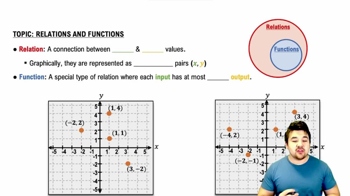
Relations and Functions

Distance Between Two Points

The distance between the two particles at any time t can be determined by the absolute difference of their position functions: |s₁ - s₂|. This concept is essential for solving the problem, as it allows us to quantify how far apart the particles are at any moment, which is necessary to find the maximum distance.
Recommended video:
Guided course
5:04
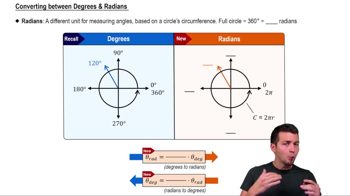
Converting between Degrees & Radians

Maximization Techniques

To find the farthest distance between the two particles, we need to apply techniques of maximization, often involving calculus. This may include finding critical points by taking the derivative of the distance function and setting it to zero, as well as evaluating endpoints or using the second derivative test to confirm maximum values.
Recommended video:
04:18
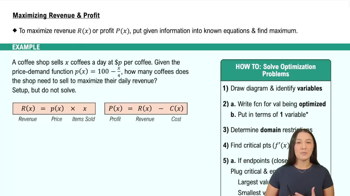
Maximizing Profit & Revenue