Ch. 4 - Applications of Derivatives
Hass - Thomas' Calculus 15th Edition
Hass15th EditionThomas' CalculusISBN: 9780137616077Not the one you use?Change textbook
Chapter 4, Problem 123

In Exercises 121–124, find the inflection points (if any) on the graph of the function and the coordinates of the points on the graph where the function has a local maximum or local minimum value. Then graph the function in a region large enough to show all these points simultaneously. Add to your picture the graphs of the function’s first and second derivatives. How are the values at which these graphs intersect the x-axis related to the graph of the function? In what other ways are the graphs of the derivatives related to the graph of the function?
123. y=(4/5)x^5+16x^2-25

Verified step by step guidance
1
To find the inflection points, we need to determine where the second derivative of the function changes sign. Start by finding the first derivative of the function \( y = \frac{4}{5}x^5 + 16x^2 - 25 \). Use the power rule to differentiate: \( y' = \frac{d}{dx}(\frac{4}{5}x^5) + \frac{d}{dx}(16x^2) - \frac{d}{dx}(25) \).
Calculate the first derivative: \( y' = \frac{4}{5} \cdot 5x^4 + 32x = 4x^4 + 32x \).
Next, find the second derivative by differentiating the first derivative: \( y'' = \frac{d}{dx}(4x^4 + 32x) \). Apply the power rule again: \( y'' = 16x^3 + 32 \).
To find the inflection points, solve \( y'' = 0 \) for \( x \). Set \( 16x^3 + 32 = 0 \) and solve for \( x \).
To find local maxima and minima, use the first derivative test. Set \( y' = 0 \) and solve for \( x \). This will give you the critical points. Then, use the second derivative test to determine the nature of these critical points: if \( y'' > 0 \), it's a local minimum; if \( y'' < 0 \), it's a local maximum.

Verified video answer for a similar problem:

This video solution was recommended by our tutors as helpful for the problem above.
Video duration:
3m
Was this helpful?

Key Concepts

Here are the essential concepts you must grasp in order to answer the question correctly.

Inflection Points

Inflection points occur where the concavity of a function changes, which is determined by the second derivative. To find inflection points, set the second derivative equal to zero and solve for x. Verify a change in concavity by checking the sign of the second derivative around these points.
Recommended video:
04:50
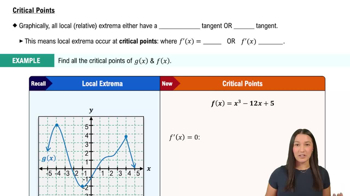
Critical Points

Local Maximum and Minimum

Local maxima and minima are points where a function reaches a highest or lowest value in a neighborhood. These can be found using the first derivative test, where the derivative changes sign, or the second derivative test, where the second derivative is positive (minimum) or negative (maximum) at critical points.
Recommended video:
06:02
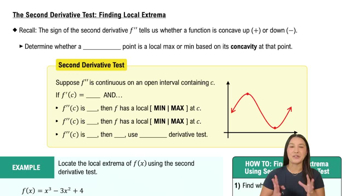
The Second Derivative Test: Finding Local Extrema

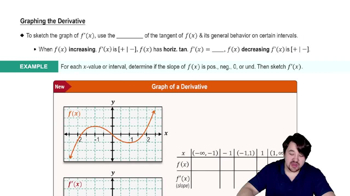
Graphing Derivatives

The first derivative of a function represents its slope, and where it intersects the x-axis indicates critical points. The second derivative indicates concavity, and its x-axis intersections suggest potential inflection points. Graphing these derivatives alongside the original function helps visualize these relationships and understand the function's behavior.
Recommended video:
06:15
Graphing The Derivative