
Ch. 4 - Applications of Derivatives
Hass - Thomas' Calculus 15th Edition
Hass15th EditionThomas' CalculusISBN: 9780137616077Not the one you use?Change textbook
Chapter 4, Problem 4.7.21

Finding Indefinite Integrals


In Exercises 17–56, find the most general antiderivative or indefinite integral. You may need to try a solution and then adjust your guess. Check your answers by differentiation.


∫(2x³ − 5x + 7) dx

Verified step by step guidance
1
Identify the integral to solve: \(\int (2x^{3} - 5x + 7) \, dx\).
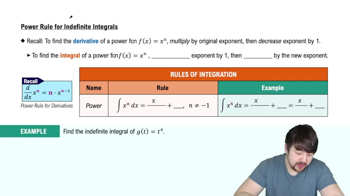
Recall the power rule for integration: \(\int x^{n} \, dx = \frac{x^{n+1}}{n+1} + C\), where \(n \neq -1\).
Apply the power rule to each term separately: integrate \$2x^{3}\(, \)-5x$, and \(7\) individually.
For \$2x^{3}\(, multiply the coefficient by the integral of \)x^{3}\(: \(2 \times \frac{x^{4}}{4}\); for \)-5x\(, integrate \)x\( as \(\frac{x^{2}}{2}\) and multiply by \)-5\(; for the constant \(7\), integrate as \)7x$.
Combine all integrated terms and add the constant of integration \(C\) to write the most general antiderivative.

Verified video answer for a similar problem:

This video solution was recommended by our tutors as helpful for the problem above.
Video duration:
2m
Was this helpful?

Key Concepts

Here are the essential concepts you must grasp in order to answer the question correctly.

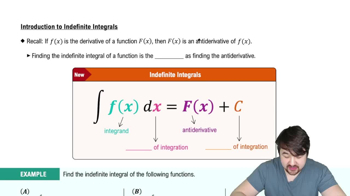
Indefinite Integral

An indefinite integral represents the most general antiderivative of a function, expressed as a family of functions plus a constant of integration. It reverses differentiation and is written without limits, indicating all possible antiderivatives.
Recommended video:
05:04
Introduction to Indefinite Integrals

Power Rule for Integration

The power rule states that the integral of x^n (where n ≠ -1) is (x^(n+1))/(n+1) plus a constant. This rule is essential for integrating polynomial terms like x³ or x, allowing straightforward calculation of their antiderivatives.
Recommended video:
04:04
Power Rule for Indefinite Integrals

Verification by Differentiation

After finding an indefinite integral, differentiating the result should return the original integrand. This step confirms the correctness of the antiderivative and helps identify any errors in the integration process.
Recommended video:
05:53
Finding Differentials