
Textbook Question
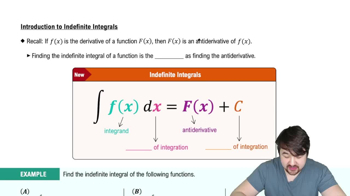
Finding Indefinite Integrals
In Exercises 17–56, find the most general antiderivative or indefinite integral. You may need to try a solution and then adjust your guess. Check your answers by differentiation.
∫(sin2x − csc²x)dx

 Verified step by step guidance
 05:04
05:04
 06:18
06:18 05:53
05:53Finding Indefinite Integrals
In Exercises 17–56, find the most general antiderivative or indefinite integral. You may need to try a solution and then adjust your guess. Check your answers by differentiation.
∫(sin2x − csc²x)dx
Checking Antiderivative Formulas
Verify the formulas in Exercises 57–62 by differentiation.
∫csc²((x − 1)/3)dx = −3cot((x − 1)/3) + C
Checking the Mean Value Theorem
Which of the functions in Exercises 7–12 satisfy the hypotheses of the Mean Value Theorem on the given interval, and which do not? Give reasons for your answers.
f(x) = {sinx / x, −π ≤ x < 0
0, x = 0
Finding Extrema from Graphs
In Exercises 15–20, sketch the graph of each function and determine whether the function has any absolute extreme values on its domain. Explain how your answer is consistent with Theorem 1.
f(x) = |x|, −1 < x < 2
Absolute Extrema on Finite Closed Intervals
In Exercises 37–40, find the function’s absolute maximum and minimum values and say where they occur.
f(x) = x⁴ᐟ³, −1 ≤ x ≤ 8
Absolute Extrema on Finite Closed Intervals
In Exercises 21–36, find the absolute maximum and minimum values of each function on the given interval. Then graph the function. Identify the points on the graph where the absolute extrema occur, and include their coordinates.
h(x) = ³√x, −1 ≤ x ≤ 8