
Ch. 4 - Applications of Derivatives
Hass - Thomas' Calculus 15th Edition
Hass15th EditionThomas' CalculusISBN: 9780137616077Not the one you use?Change textbook
Chapter 4, Problem 29a

Finding Functions from Derivatives


Suppose that f'(x) = 2x for all x. Find f(2) if


a. f(0) = 0

Verified step by step guidance
1
Start by recognizing that f'(x) = 2x is the derivative of the function f(x). To find f(x), we need to integrate f'(x).
Set up the integral of f'(x) = 2x with respect to x: ∫2x dx.
Perform the integration: The integral of 2x with respect to x is x^2 + C, where C is the constant of integration.
Use the initial condition f(0) = 0 to find the constant C. Substitute x = 0 into the equation f(x) = x^2 + C, giving f(0) = 0^2 + C = 0, which implies C = 0.
Now that we have f(x) = x^2, substitute x = 2 into the function to find f(2): f(2) = 2^2.

Verified video answer for a similar problem:

This video solution was recommended by our tutors as helpful for the problem above.
Video duration:
3m
Was this helpful?

Key Concepts

Here are the essential concepts you must grasp in order to answer the question correctly.

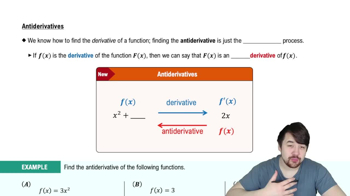
Antiderivatives

An antiderivative of a function f'(x) is a function f(x) whose derivative is f'(x). To find f(x) from f'(x) = 2x, we integrate 2x with respect to x, resulting in f(x) = x^2 + C, where C is the constant of integration.
Recommended video:
05:50
Antiderivatives

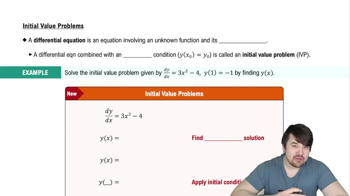
Initial Conditions

Initial conditions are specific values that allow us to determine the constant of integration when finding an antiderivative. Given f(0) = 0, we substitute x = 0 into f(x) = x^2 + C, yielding 0 = 0^2 + C, which implies C = 0.
Recommended video:
05:03
Initial Value Problems

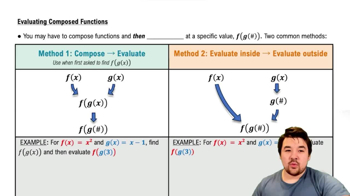
Evaluating Functions

Once the function f(x) is determined, we can evaluate it at specific points. With f(x) = x^2 and C = 0, we find f(2) by substituting x = 2, resulting in f(2) = 2^2 = 4.
Recommended video:
4:26
Evaluating Composed Functions