Ch. 4 - Applications of Derivatives
Hass - Thomas' Calculus 15th Edition
Hass15th EditionThomas' CalculusISBN: 9780137616077Not the one you use?Change textbook
Chapter 4, Problem 4.7.15c

Finding Antiderivatives
In Exercises 1–16, find an antiderivative for each function. Do as many as you can mentally. Check your answers by differentiation.
−π csc (πx/2) cot (πx/2)

Verified step by step guidance
1
Recognize that the given function is \(-\pi \csc\left(\frac{\pi x}{2}\right) \cot\left(\frac{\pi x}{2}\right)\), which involves trigonometric functions cosecant and cotangent with an inner function \(\frac{\pi x}{2}\).
Recall the derivative formula: \(\frac{d}{dx}[\csc(u)] = -\csc(u) \cot(u) \cdot u'\) where \(u\) is a function of \(x\).
Identify the inner function \(u = \frac{\pi x}{2}\), so its derivative is \(u' = \frac{\pi}{2}\).
Notice that the given function resembles the derivative of \(\csc\left(\frac{\pi x}{2}\right)\) multiplied by a constant. Use this to set up the antiderivative as a constant multiple of \(\csc\left(\frac{\pi x}{2}\right)\).
Adjust the constant factor to account for the difference between the given function and the derivative formula, then write the antiderivative as \(F(x) = A \csc\left(\frac{\pi x}{2}\right) + C\), where \(A\) is the constant to be determined and \(C\) is the constant of integration.

Verified video answer for a similar problem:

This video solution was recommended by our tutors as helpful for the problem above.
Video duration:
4m
Was this helpful?

Key Concepts

Here are the essential concepts you must grasp in order to answer the question correctly.

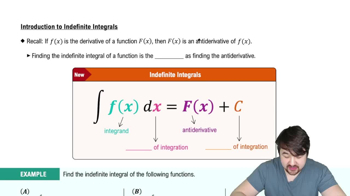
Antiderivatives (Indefinite Integrals)

An antiderivative of a function is another function whose derivative equals the original function. Finding antiderivatives involves reversing differentiation, often represented as an indefinite integral with a constant of integration. This process helps solve problems involving accumulation and area under curves.
Recommended video:
05:04
Introduction to Indefinite Integrals

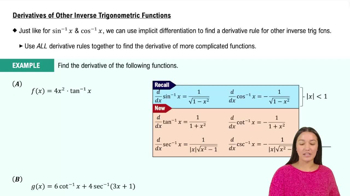
Trigonometric Functions and Their Derivatives

Understanding the derivatives of trigonometric functions like sine, cosine, cosecant, and cotangent is essential. For example, the derivative of cotangent is -csc²(x), and the derivative of cosecant is -csc(x)cot(x). Recognizing these relationships aids in identifying antiderivatives involving trigonometric expressions.
Recommended video:
06:35
Derivatives of Other Inverse Trigonometric Functions

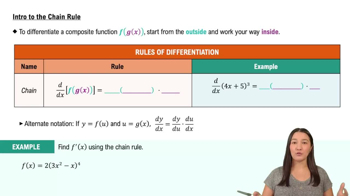
Chain Rule and Substitution Method

The chain rule helps differentiate composite functions, and its reverse is used in integration by substitution. When the integrand involves a function and its derivative, substitution simplifies finding antiderivatives. This technique is crucial for handling functions like csc(πx/2) cot(πx/2) where the argument is a linear function of x.
Recommended video:
05:02
Intro to the Chain Rule