
Textbook Question
Analyzing Functions from Derivatives
Answer the following questions about the functions whose derivatives are given in Exercises 1–14:
c. At what points, if any, does f assume local maximum or minimum values?
f′(x) = x(x − 1)

 Verified step by step guidance
 05:04
05:04
 06:35
06:35 05:02
05:02Analyzing Functions from Derivatives
Answer the following questions about the functions whose derivatives are given in Exercises 1–14:
c. At what points, if any, does f assume local maximum or minimum values?
f′(x) = x(x − 1)
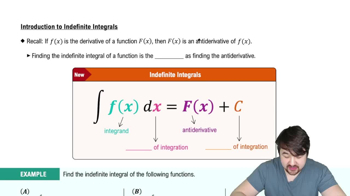
Checking Antiderivative Formulas
Right, or wrong? Say which for each formula and give a brief reason for each answer.
∫tanθ sec²θ dθ = (1/2) sec²θ + C
Theory and Examples
In Exercises 51 and 52, give reasons for your answers.
Let f(x) = |x³ − 9x|.
b. Does f'(-3) exist?
Analyzing Functions from Derivatives
Answer the following questions about the functions whose derivatives are given in Exercises 1–14:
c. At what points, if any, does f assume local maximum or minimum values?
f′(x) = (x − 1)²(x + 2)
Finding displacement from an antiderivative of velocity
a. Suppose that the velocity of a body moving along the s-axis is
ds/dt = v = 9.8t − 3.
iii. Now find the body’s displacement from t = 1 to t = 3 given that s = s₀ when t = 0.
105. Motion Along a Line The graphs in Exercises 105 and 106 show the position s=f(t) of an object moving up and down on a coordinate line. At approximately what times is the (c) Acceleration equal to zero?