
Ch. 4 - Applications of Derivatives
Hass - Thomas' Calculus 15th Edition
Hass15th EditionThomas' CalculusISBN: 9780137616077Not the one you use?Change textbook
Chapter 4, Problem 47

Each of Exercises 43–48 gives the first derivative of a function y = ƒ(𝓍). (a) At what points, if any, does the graph of ƒ have a local maximum, local minimum, or inflection point? (b) Sketch the general shape of the graph.
y' = 𝓍⁴ ― 2𝓍² 

Verified step by step guidance
1
First, identify the critical points by setting the first derivative y' = 𝓍⁴ - 2𝓍² equal to zero and solving for 𝓍. This will help us find potential points for local maxima, minima, or inflection points.
Factor the equation 𝓍⁴ - 2𝓍² = 0 to simplify the process of finding critical points. Notice that it can be factored as 𝓍²(𝓍² - 2) = 0.
Solve the factored equation 𝓍²(𝓍² - 2) = 0. This gives us 𝓍² = 0 or 𝓍² = 2. From 𝓍² = 0, we get 𝓍 = 0. From 𝓍² = 2, we get 𝓍 = ±√2.
To determine the nature of each critical point (local maximum, minimum, or inflection point), use the second derivative test. Compute the second derivative y'' by differentiating y' = 𝓍⁴ - 2𝓍² again.
Evaluate the second derivative at each critical point (𝓍 = 0, 𝓍 = ±√2) to determine concavity. If y'' > 0, the point is a local minimum; if y'' < 0, it's a local maximum; if y'' = 0, further analysis is needed to determine if it's an inflection point.

Verified video answer for a similar problem:

This video solution was recommended by our tutors as helpful for the problem above.
Video duration:
9m
Was this helpful?

Key Concepts

Here are the essential concepts you must grasp in order to answer the question correctly.

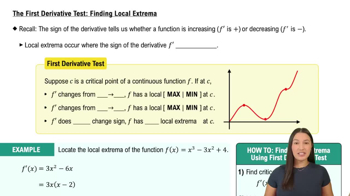
First Derivative Test

The First Derivative Test is a method used to determine local extrema of a function. By analyzing the sign of the first derivative, we can identify where the function is increasing or decreasing. A local maximum occurs where the derivative changes from positive to negative, while a local minimum occurs where it changes from negative to positive. Critical points, where the derivative is zero or undefined, are essential for applying this test.
Recommended video:
07:09
The First Derivative Test: Finding Local Extrema

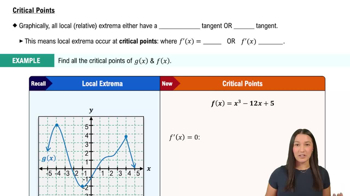
Inflection Points

Inflection points are points on the graph of a function where the concavity changes. This means that the second derivative of the function changes sign at these points. To find inflection points, we first need to compute the second derivative and identify where it equals zero or is undefined. Understanding inflection points helps in sketching the graph and analyzing the behavior of the function.
Recommended video:
04:50
Critical Points

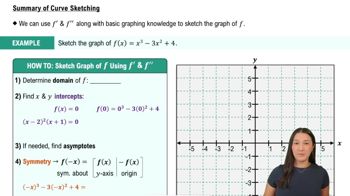
Graph Sketching

Graph sketching involves creating a rough representation of a function based on its critical points, local extrema, and inflection points. By using information from the first and second derivatives, we can determine the overall shape of the graph, including where it rises, falls, and changes concavity. This visual representation aids in understanding the function's behavior and is crucial for interpreting the results of derivative analysis.
Recommended video:
11:41
Summary of Curve Sketching
Related Practice
Textbook Question

The range R of a projectile fired from the origin over horizontal ground is the distance from the origin to the point of impact. If the projectile is fired with an initial velocity at an angle with the horizontal, then in Chapter 13 we find that R-v_0^2/g(sin 2α) where g is the downward acceleration due to gravity. Find the angle α for which the range R is the largest possible.

Textbook Question

In Exercises 49–52, graph each function. Then use the function’s first derivative to explain what you see.

y = 𝓍²/³ + (𝓍―1)²/³ 

Textbook Question

In Exercises 9–66, graph the function using appropriate methods from the graphing procedures presented just before Example 9, identifying the coordinates of any local extreme points and inflection points. Then find coordinates of absolute extreme points, if any.

46. y = cos(x) + √3 * sin(x), 0 ≤ x ≤ 2π

Textbook Question

Applications


Classical accounts tell us that a 170-oar trireme (ancient Greek or Roman warship) once covered 184 sea miles in 24 hours. Explain why at some point during this feat the trireme’s speed exceeded 7.5 knots (sea or nautical miles per hour).

Textbook Question

Each of Exercises 43–48 gives the first derivative of a function y = ƒ(𝓍). (a) At what points, if any, does the graph of ƒ have a local maximum, local minimum, or inflection point? (b) Sketch the general shape of the graph.

y' = 𝓍² ― 𝓍―6

Textbook Question

Finding Position from Velocity or Acceleration


Exercises 45–48 give the acceleration a=d²s/dt², initial velocity, and initial position of an object moving on a coordinate line. Find the object’s position at time t.


a = 32, v(0) = 20, s(0) = 5