Ch. 4 - Applications of Derivatives
Hass - Thomas' Calculus 15th Edition
Hass15th EditionThomas' CalculusISBN: 9780137616077Not the one you use?Change textbook
Chapter 4, Problem 4.7.109e

Applications


Suppose that f(x) = d/dx (1 − √x) and g(x) = d/dx (x + 2).


Find:


∫[f(x) + g(x)] dx

Verified step by step guidance
1
First, identify the functions f(x) and g(x) as derivatives of given expressions. Specifically, f(x) = \(\frac{d}{dx}\) (1 - \(\sqrt{x}\)) and g(x) = \(\frac{d}{dx}\) (x + 2).
Next, compute f(x) by differentiating the function inside: recall that \(\sqrt{x}\) = x^{1/2}, so use the power rule for derivatives to find \(\frac{d}{dx}\) (1 - x^{1/2}).
Similarly, compute g(x) by differentiating the function inside: \(\frac{d}{dx}\) (x + 2), which involves differentiating a linear function.
After finding explicit expressions for f(x) and g(x), write the integral as \(\int\) [f(x) + g(x)] \, dx = \(\int\) f(x) \, dx + \(\int\) g(x) \, dx.
Finally, integrate each term separately. Since f(x) and g(x) are derivatives of known functions, integrating them will return the original functions (up to a constant). Combine the results and include the constant of integration.

Verified video answer for a similar problem:

This video solution was recommended by our tutors as helpful for the problem above.
Video duration:
4m
Was this helpful?

Key Concepts

Here are the essential concepts you must grasp in order to answer the question correctly.

Derivative and Differentiation

The derivative of a function represents its instantaneous rate of change with respect to the variable. Differentiation rules, such as the power rule, allow us to find derivatives of functions like √x or polynomials. Understanding how to compute derivatives is essential to identify f(x) and g(x) in the problem.
Recommended video:
05:53
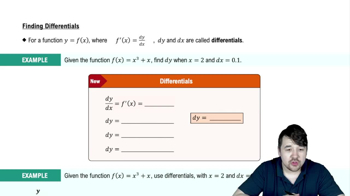
Finding Differentials

Integration as the Inverse of Differentiation

Integration is the reverse process of differentiation, used to find the original function given its derivative. The integral of a sum of functions equals the sum of their integrals. Recognizing that ∫[f(x) + g(x)] dx can be simplified by integrating each term separately is key to solving the problem.
Recommended video:
04:51
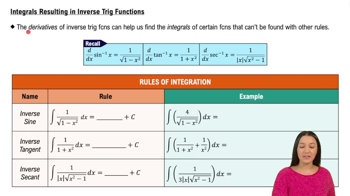
Integrals Resulting in Inverse Trig Functions

Properties of Definite and Indefinite Integrals

Indefinite integrals represent families of functions differing by a constant. When integrating derivatives, the result returns the original function plus a constant of integration. This concept helps in understanding that integrating f(x) + g(x), where f and g are derivatives, recovers the sum of the original functions.
Recommended video:
05:43
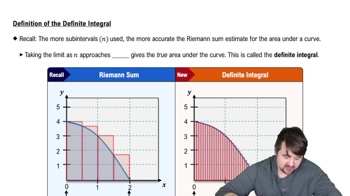
Definition of the Definite Integral
Related Practice
Textbook Question

Theory and Examples


In Exercises 51 and 52, give reasons for your answers.


Let f(x) = |x³ − 9x|.


d. Determine all extrema of f.

Textbook Question

In Exercises 9–66, graph the function using appropriate methods from the graphing procedures presented just before Example 9, identifying the coordinates of any local extreme points and inflection points. Then find coordinates of absolute extreme points, if any.

y = (x² - 49) / (x² + 5x - 14)

Textbook Question

In Exercises 9–66, graph the function using appropriate methods from the graphing procedures presented just before Example 9, identifying the coordinates of any local extreme points and inflection points. Then find coordinates of absolute extreme points, if any.

y=1-(x+1)^3

Textbook Question

Finding Antiderivatives

In Exercises 1–16, find an antiderivative for each function. Do as many as you can mentally. Check your answers by differentiation.

x⁻⁴ + 2x + 3

1
views
Textbook Question

The Mean Value Theorem                                                                                                                                                                  


 a. Show that the equation 𝓍⁴ + 2𝓍² ― 2 = 0 has exactly one solution on [0,1] .


[Technology Exercises] b.Find the solution to as many decimal places as you can.  

Textbook Question

106. Motion Along a Line The graphs in Exercises 105 and 106 show the position s=f(t) of an object moving up and down on a coordinate line. At approximately what times is the (d) When is the acceleration positive? Negative?