
Ch. 3 - Derivatives
Hass - Thomas' Calculus 15th Edition
Hass15th EditionThomas' CalculusISBN: 9780137616077Not the one you use?Change textbook
Chapter 3, Problem 27

Vehicular stopping distance Based on data from the U.S. Bureau of Public Roads, a model for the total stopping distance of a moving car in terms of its speed is s = 1.1v + 0.054v², where s is measured in ft and v in mph. The linear term 1.1v models the distance the car travels during the time the driver perceives a need to stop until the brakes are applied, and the quadratic term 0.054v² models the additional braking distance once they are applied. Find ds/dv at v = 35 and v = 70 mph, and interpret the meaning of the derivative.

Verified step by step guidance
1
First, identify the function given for the stopping distance: s = 1.1v + 0.054v². This function represents the total stopping distance in terms of the car's speed v.
To find the derivative ds/dv, apply the rules of differentiation to each term in the function. The derivative of a constant times a variable, such as 1.1v, is simply the constant. The derivative of 0.054v² is found using the power rule, which states that d/dx of x^n is n*x^(n-1).
Calculate the derivative of the linear term: d/dv of 1.1v is 1.1.
Calculate the derivative of the quadratic term: d/dv of 0.054v² is 2 * 0.054 * v^(2-1) = 0.108v.
Combine the derivatives to find ds/dv: ds/dv = 1.1 + 0.108v. Evaluate this derivative at v = 35 mph and v = 70 mph to understand how the stopping distance changes with speed. The derivative represents the rate of change of stopping distance with respect to speed, indicating how much the stopping distance increases for each additional mph of speed.

Verified video answer for a similar problem:

This video solution was recommended by our tutors as helpful for the problem above.
Video duration:
2m
Was this helpful?

Key Concepts

Here are the essential concepts you must grasp in order to answer the question correctly.

Derivative

The derivative of a function represents the rate at which the function's value changes with respect to changes in its input. In this context, ds/dv is the derivative of the stopping distance s with respect to speed v, indicating how the stopping distance changes as the speed of the car changes. Calculating this derivative helps understand the sensitivity of stopping distance to changes in speed.
Recommended video:
05:44
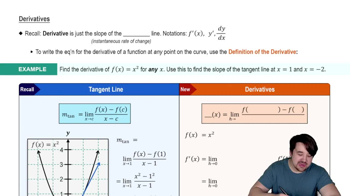
Derivatives

Power Rule for Differentiation

The power rule is a basic rule in calculus used to find the derivative of a function of the form f(x) = ax^n. The derivative is given by f'(x) = n*ax^(n-1). For the stopping distance function s = 1.1v + 0.054v², applying the power rule allows us to differentiate each term separately, resulting in ds/dv = 1.1 + 0.108v, which can then be evaluated at specific speeds.
Recommended video:
04:02
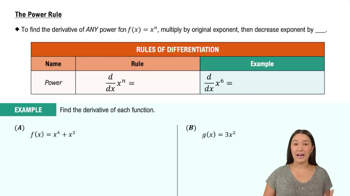
The Power Rule

Interpretation of Derivatives in Context

Interpreting the derivative in the context of the problem involves understanding what the calculated rate of change signifies in real-world terms. For the stopping distance model, ds/dv at a specific speed tells us how much the stopping distance is expected to increase for each additional mph of speed. This interpretation is crucial for assessing safety and understanding the impact of speed on stopping distance.
Recommended video:
05:44
Derivatives
Related Practice
Textbook Question

Slopes and Tangent Lines


a. Horizontal tangent lines Find equations for the horizontal tangent lines to the curve y = x³ − 3x − 2. Also find equations for the lines that are perpendicular to these tangent lines at the points of tangency.

1
views
Textbook Question

The number of gallons of water in a tank t minutes after the tank has started to drain is Q(t) = 200(30 - t)². How fast is the water running out at the end of 10 min? What is the average rate at which the water flows out during the first 10 min?

Textbook Question

[Technology Exercise]


Draining a tank It takes 12 hours to drain a storage tank by opening the valve at the bottom. The depth y of fluid in the tank t hours after the valve is opened is given by the formula


y = 6(1 - t/12)² m.


a. Find the rate dy/dt (m/h) at which the tank is draining at time t.

1
views
Textbook Question

[Technology Exercise]


Draining a tank It takes 12 hours to drain a storage tank by opening the valve at the bottom. The depth y of fluid in the tank t hours after the valve is opened is given by the formula


y = 6(1 - t/12)² m.


b. When is the fluid level in the tank falling fastest? Slowest? What are the values of dy/dt at these times?

Textbook Question

Slopes and Tangent Lines


b. Smallest slope What is the smallest slope on the curve? At what point on the curve does the curve have this slope?

1
views
Textbook Question

Airplane takeoff Suppose that the distance an aircraft travels along a runway before takeoff is given by D = (10/9)t², where D is measured in meters from the starting point and t is measured in seconds from the time the brakes are released. The aircraft will become airborne when its speed reaches 200 km/h. How long will it take to become airborne, and what distance will it travel in that time?

1
views