
Ch. 3 - Derivatives
Hass - Thomas' Calculus 15th Edition
Hass15th EditionThomas' CalculusISBN: 9780137616077Not the one you use?Change textbook
Chapter 3, Problem 3.9.45a

The radius r of a circle is measured with an error of at most 2%. What is the maximum corresponding percentage error in computing the circle’s


a. circumference?

Verified step by step guidance
1
Understand the relationship between the radius and the circumference of a circle. The formula for the circumference C of a circle is given by: C=2πr.
Recognize that the error in the radius will affect the circumference. If the radius r has an error, the circumference C will also have an error. We need to find the relationship between the percentage error in r and the percentage error in C.
Use the concept of differentials to approximate the error in the circumference. The differential of the circumference dC is given by: dC=2πdr.
Calculate the relative error in the circumference. The relative error in C is given by: dCC=2πdr2πr=drr.
Since the error in the radius is at most 2%, the maximum percentage error in the circumference is the same as the percentage error in the radius, which is 2%.

Verified video answer for a similar problem:

This video solution was recommended by our tutors as helpful for the problem above.
Video duration:
3m
Was this helpful?

Key Concepts

Here are the essential concepts you must grasp in order to answer the question correctly.

Differential Error Analysis

Differential error analysis involves using calculus to approximate the change in a function's output based on small changes in its input. For a function f(x), the differential df represents the change in f due to a small change dx in x. This concept is crucial for understanding how errors in measurement propagate through calculations.
Recommended video:
04:57
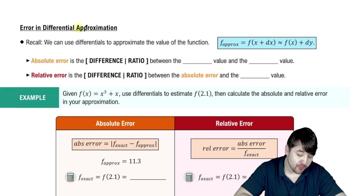
Determining Error and Relative Error

Circumference of a Circle

The circumference of a circle is calculated using the formula C = 2πr, where r is the radius. Understanding this formula is essential because it directly relates the radius to the circumference, allowing us to analyze how errors in measuring the radius affect the circumference.
Recommended video:
5:10
Evaluate Composite Functions - Values on Unit Circle

Percentage Error

Percentage error quantifies the error in a measurement as a percentage of the true value. It is calculated as (error/true value) × 100%. In this context, understanding percentage error helps in determining how a 2% error in the radius measurement affects the calculated circumference.
Recommended video:
04:57
Determining Error and Relative Error