Ch. 3 - Derivatives
Hass - Thomas' Calculus 15th Edition
Hass15th EditionThomas' CalculusISBN: 9780137616077Not the one you use?Change textbook
Chapter 3, Problem 3.3.66

The best quantity to order One of the formulas for inventory management says that the average weekly cost of ordering, paying for, and holding merchandise is
A(q) = (km / q) + cm + (hq / 2),
where q is the quantity you order when things run low (shoes, TVs, brooms, or whatever the item might be); k is the cost of placing an order (the same, no matter how often you order); c is the cost of one item (a constant); m is the number of items sold each week (a constant); and h is the weekly holding cost per item (a constant that takes into account things such as space, utilities, insurance, and security).
Find dA/dq and d²A/dq².

Verified step by step guidance
1
Identify the function A(q) given in the problem: A(q) = (km / q) + cm + (hq / 2). This is the function for which we need to find the first and second derivatives with respect to q.
To find the first derivative, dA/dq, apply the power rule and the constant rule. The term (km / q) can be rewritten as km * q^(-1). The derivative of cm with respect to q is 0 since it is a constant. The derivative of (hq / 2) is h/2 since it is a linear term in q.
Calculate the derivative of the first term: d/dq [km * q^(-1)] = -km * q^(-2).
Combine the derivatives to find dA/dq: dA/dq = -km * q^(-2) + 0 + h/2.
To find the second derivative, d²A/dq², differentiate dA/dq with respect to q. The derivative of -km * q^(-2) is 2km * q^(-3), and the derivative of h/2 is 0 since it is a constant. Thus, d²A/dq² = 2km * q^(-3).

Verified video answer for a similar problem:

This video solution was recommended by our tutors as helpful for the problem above.
Video duration:
3m
Was this helpful?

Key Concepts

Here are the essential concepts you must grasp in order to answer the question correctly.

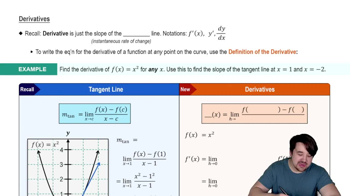
Derivative

The derivative of a function measures how the function's output value changes as its input changes. In this context, finding dA/dq involves applying differentiation rules to determine how the average weekly cost A(q) changes with respect to the order quantity q. This helps in understanding the rate of change of cost with varying order sizes.
Recommended video:
05:44
Derivatives

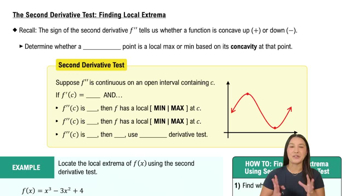
Second Derivative

The second derivative, denoted as d²A/dq², provides information about the curvature or concavity of the function A(q). It indicates whether the function is concave up or down, which is crucial for identifying local minima or maxima. In inventory management, this helps determine the optimal order quantity that minimizes costs.
Recommended video:
06:02
The Second Derivative Test: Finding Local Extrema

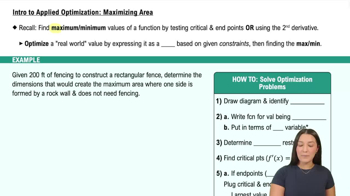
Optimization

Optimization involves finding the best solution from a set of possible choices. In this problem, it refers to determining the order quantity q that minimizes the average weekly cost A(q). By analyzing the first and second derivatives, one can identify critical points and assess their nature to find the optimal order size that balances ordering and holding costs.
Recommended video:
10:13
Intro to Applied Optimization: Maximizing Area