Ch. 3 - Derivatives
Hass - Thomas' Calculus 15th Edition
Hass15th EditionThomas' CalculusISBN: 9780137616077Not the one you use?Change textbook
Chapter 3, Problem 46

Quadratics having a common tangent line The curves y = x² + ax + b and y = cx − x² have a common tangent line at the point (1,0). Find a, b, and c.

Verified step by step guidance
1
First, find the derivative of each curve to determine the slope of the tangent line. For the curve y = x² + ax + b, the derivative is dy/dx = 2x + a. For the curve y = cx - x², the derivative is dy/dx = c - 2x.
Since the curves have a common tangent line at the point (1,0), the slopes of the tangent lines at x = 1 must be equal. Set the derivatives equal at x = 1: 2(1) + a = c - 2(1).
Solve the equation from the previous step to find a relationship between a and c: 2 + a = c - 2.
Next, ensure that the point (1,0) lies on both curves. Substitute x = 1 and y = 0 into each curve equation. For y = x² + ax + b, substitute to get 0 = 1² + a(1) + b. For y = cx - x², substitute to get 0 = c(1) - 1².
Solve the system of equations obtained from the previous steps to find the values of a, b, and c. Use the relationships: 0 = 1 + a + b and 0 = c - 1, along with the equation 2 + a = c - 2, to find the values of a, b, and c.

Verified video answer for a similar problem:

This video solution was recommended by our tutors as helpful for the problem above.
Video duration:
4m
Was this helpful?

Key Concepts

Here are the essential concepts you must grasp in order to answer the question correctly.

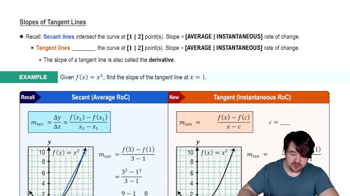
Tangent Line

A tangent line to a curve at a given point is a straight line that touches the curve at that point and has the same slope as the curve at that point. To find the tangent line, we need to calculate the derivative of the function at the point of tangency, which gives us the slope, and then use the point-slope form of a line to express the tangent.
Recommended video:
05:13
Slopes of Tangent Lines

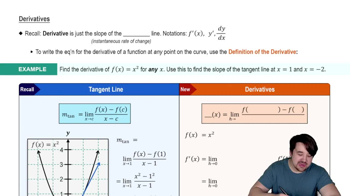
Derivatives

Derivatives represent the rate of change of a function with respect to its variable. In this context, we will differentiate both quadratic functions to find their slopes at the point (1,0). Setting these derivatives equal at the point of tangency will help us establish a relationship between the coefficients a, b, and c.
Recommended video:
05:44
Derivatives

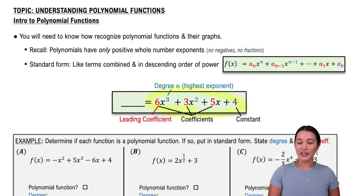
Quadratic Functions

Quadratic functions are polynomial functions of degree two, typically expressed in the form y = ax² + bx + c. In this problem, we are dealing with two specific quadratic functions, and understanding their properties, such as vertex, axis of symmetry, and how they can intersect or share tangent lines, is crucial for solving for the unknown coefficients.
Recommended video:
6:04
Introduction to Polynomial Functions