
Ch. 3 - Derivatives
Hass - Thomas' Calculus 15th Edition
Hass15th EditionThomas' CalculusISBN: 9780137616077Not the one you use?Change textbook
Chapter 3, Problem 3.4.8b

Particle motion At time t ≥ 0, the velocity of a body moving along the horizontal s-axis is v = t² − 4t + 3.


b. When is the body moving forward? Backward?

Verified step by step guidance
1
To determine when the body is moving forward or backward, we need to analyze the velocity function v(t) = t² − 4t + 3.
The body is moving forward when the velocity v(t) is greater than zero, and moving backward when v(t) is less than zero.
First, find the critical points by setting the velocity function equal to zero: t² − 4t + 3 = 0. Solve this quadratic equation to find the values of t where the velocity changes sign.
Use the quadratic formula t = (-b ± √(b² - 4ac)) / 2a, where a = 1, b = -4, and c = 3, to find the roots of the equation.
Once the critical points are found, test intervals around these points to determine the sign of v(t) in each interval. This will tell you when the body is moving forward (v(t) > 0) and when it is moving backward (v(t) < 0).

Verified video answer for a similar problem:

This video solution was recommended by our tutors as helpful for the problem above.
Video duration:
4m
Was this helpful?

Key Concepts

Here are the essential concepts you must grasp in order to answer the question correctly.

Velocity and Direction

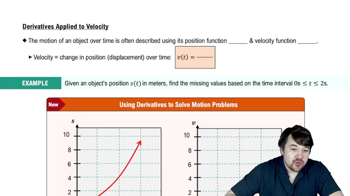
Velocity indicates the speed and direction of a particle's motion along a path. A positive velocity means the particle is moving forward, while a negative velocity indicates backward motion. To determine when the body moves forward or backward, analyze the sign of the velocity function over time.
Recommended video:
06:29
Derivatives Applied To Velocity

Quadratic Functions

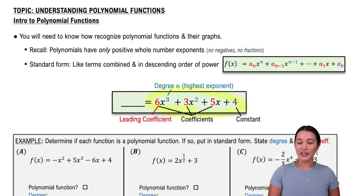
The velocity function v = t² − 4t + 3 is a quadratic function, which is characterized by its parabolic graph. The roots of the quadratic equation, found using the quadratic formula, indicate the points where the velocity changes sign, helping to identify intervals of forward and backward motion.
Recommended video:
6:04
Introduction to Polynomial Functions

Solving Inequalities

To determine when the body moves forward or backward, solve the inequality v(t) > 0 for forward motion and v(t) < 0 for backward motion. This involves finding the roots of the quadratic equation and testing intervals between these roots to see where the inequality holds true.
Recommended video:
5:02
Solving Logarithmic Equations
Related Practice