Ch. 3 - Derivatives
Hass - Thomas' Calculus 15th Edition
Hass15th EditionThomas' CalculusISBN: 9780137616077Not the one you use?Change textbook
Chapter 3, Problem 3.5.52

Is there a value of b that will make


g(x) = { x + b, x < 0
cos x, x ≥ 0


continuous at x = 0? Differentiable at x = 0? Give reasons for your answers.

Verified step by step guidance
1
To determine if the function g(x) is continuous at x = 0, we need to check if the left-hand limit as x approaches 0 from the negative side equals the right-hand limit as x approaches 0 from the positive side, and both equal g(0).
Calculate the left-hand limit: As x approaches 0 from the left (x < 0), g(x) = x + b. The limit is lim(x→0⁻)(x + b) = 0 + b = b.
Calculate the right-hand limit: As x approaches 0 from the right (x ≥ 0), g(x) = cos(x). The limit is lim(x→0⁺)cos(x) = cos(0) = 1.
For g(x) to be continuous at x = 0, the left-hand limit must equal the right-hand limit and g(0). Therefore, set b = 1 to make the function continuous at x = 0.
To determine differentiability at x = 0, check if the derivative from the left equals the derivative from the right. The derivative of x + b is 1, and the derivative of cos(x) at x = 0 is 0. Since these derivatives are not equal, g(x) is not differentiable at x = 0.

Verified video answer for a similar problem:

This video solution was recommended by our tutors as helpful for the problem above.
Video duration:
6m
Was this helpful?

Key Concepts

Here are the essential concepts you must grasp in order to answer the question correctly.

Continuity

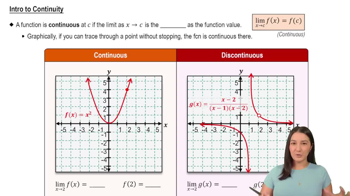
A function is continuous at a point if the limit of the function as it approaches the point from both sides equals the function's value at that point. For g(x) to be continuous at x = 0, the left-hand limit (as x approaches 0 from the left) and the right-hand limit (as x approaches 0 from the right) must both equal g(0).
Recommended video:
05:34
Intro to Continuity

Differentiability

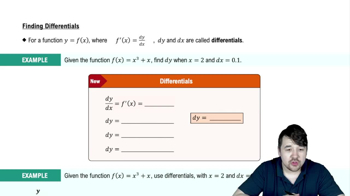
A function is differentiable at a point if it has a defined derivative at that point, meaning the function's rate of change is consistent from both sides. For g(x) to be differentiable at x = 0, it must first be continuous at x = 0, and the left-hand derivative and right-hand derivative at x = 0 must be equal.
Recommended video:
05:53
Finding Differentials

Piecewise Functions

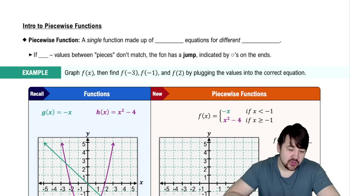
Piecewise functions are defined by different expressions over different intervals. Understanding how to evaluate limits and derivatives for each piece is crucial. For g(x), we must analyze the behavior of x + b for x < 0 and cos x for x ≥ 0 separately, then ensure they align at x = 0 for continuity and differentiability.
Recommended video:
05:36
Piecewise Functions