Find all points on the curve y = tan x, −π/2 < x < π/2, where the tangent line is parallel to the line y = 2x. Sketch the curve and tangent lines together, labeling each with its equation.

Ch. 3 - Derivatives
Chapter 3, Problem 3.8.8
If x²y³ = 4/27 and dy/dt = ¹/₂, then what is dx/dt when x = 2?
Verified step by step guidance1
First, recognize that the given equation x²y³ = 4/27 is an implicit function of x and y. We need to differentiate both sides of this equation with respect to time t to find the relationship between dx/dt and dy/dt.
Apply implicit differentiation to the equation x²y³ = 4/27 with respect to t. Use the product rule and chain rule: d/dt(x²y³) = d/dt(4/27). Since 4/27 is a constant, its derivative is 0.
Differentiate the left side: d/dt(x²y³) = 2x(dx/dt)y³ + x²(3y²)(dy/dt). This uses the product rule: d(uv)/dt = u(dv/dt) + v(du/dt), where u = x² and v = y³.
Substitute the known values into the differentiated equation: x = 2, dy/dt = 1/2, and solve for dx/dt. The equation becomes: 2(2)(dx/dt)y³ + (2)²(3y²)(1/2) = 0.
Solve the resulting equation for dx/dt. Rearrange the terms to isolate dx/dt and substitute any additional known values to find the expression for dx/dt.

Verified video answer for a similar problem:
This video solution was recommended by our tutors as helpful for the problem above.
Video duration:
6mWas this helpful?
Key Concepts
Here are the essential concepts you must grasp in order to answer the question correctly.
Implicit Differentiation
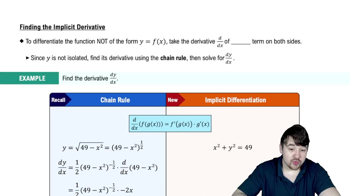
Implicit differentiation is a technique used to find the derivative of a function when it is not explicitly solved for one variable in terms of another. In this problem, the equation x²y³ = 4/27 involves both x and y, so we differentiate both sides with respect to time t, applying the chain rule to account for the derivatives of x and y.
Recommended video:
Finding The Implicit Derivative
Chain Rule
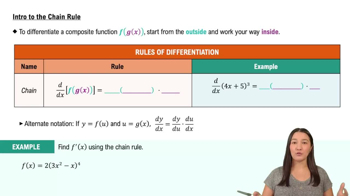
The chain rule is a fundamental principle in calculus used to differentiate composite functions. It states that the derivative of a composite function is the derivative of the outer function evaluated at the inner function times the derivative of the inner function. In this context, it helps differentiate terms like x² and y³ with respect to t, considering dx/dt and dy/dt.
Recommended video:
Intro to the Chain Rule
Solving for a Derivative
Once the implicit differentiation is performed, the next step is to solve for the desired derivative, dx/dt. This involves substituting known values, such as x = 2 and dy/dt = 1/2, into the differentiated equation and isolating dx/dt. This process requires algebraic manipulation to express dx/dt in terms of the given quantities.
Recommended video:
Solving Logarithmic Equations
Related Practice
Textbook Question
Textbook Question
Derivatives in Differential Form
In Exercises 17–28, find dy.
y = cos(x²)
Textbook Question
Approximation Error
In Exercises 29–34, each function f(x) changes value when x changes from x₀ to x₀ + dx. Find
a. the change Δf = f(x₀ + dx) − f(x₀);
b. the value of the estimate df = fʹ(x₀) dx; and
c. the approximation error |Δf − df|.
f(x) = x⁴, x₀ = 1, dx = 0.1
Textbook Question
Derivative of multiples Does knowing that a function g(t) is differentiable at t = 7 tell you anything about the differentiability of the function 3g at t = 7? Give reasons for your answer.
Textbook Question
Find the derivatives of the functions in Exercises 19–40.
y = (4x + 3)⁴(x + 1)⁻³
Textbook Question
Find the derivatives of the functions in Exercises 1–42.
𝔂 = 2 tan² x - sec² x