Ch. 3 - Derivatives
Hass - Thomas' Calculus 15th Edition
Hass15th EditionThomas' CalculusISBN: 9780137616077Not the one you use?Change textbook
Chapter 3, Problem 3.8.11a

If the original 24 m edge length x of a cube decreases at the rate of 5 m/min, when x = 3 m at what rate does the cube’s
a. surface area change?

Verified step by step guidance
1
Identify the formula for the surface area of a cube, which is given by \( S = 6x^2 \), where \( x \) is the edge length of the cube.
Differentiate the surface area \( S \) with respect to time \( t \) to find the rate of change of the surface area. Use the chain rule: \( \frac{dS}{dt} = \frac{d}{dt}(6x^2) = 12x \frac{dx}{dt} \).
Substitute the given rate of change of the edge length \( \frac{dx}{dt} = -5 \) m/min into the differentiated equation. This negative sign indicates that the edge length is decreasing.
Substitute \( x = 3 \) m into the equation \( \frac{dS}{dt} = 12x \frac{dx}{dt} \) to find the rate of change of the surface area when the edge length is 3 m.
Calculate the expression \( 12 \times 3 \times (-5) \) to determine the rate at which the surface area is changing at the moment when \( x = 3 \) m.

Verified video answer for a similar problem:

This video solution was recommended by our tutors as helpful for the problem above.
Video duration:
3m
Was this helpful?

Key Concepts

Here are the essential concepts you must grasp in order to answer the question correctly.

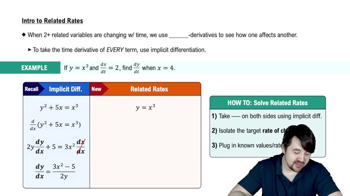
Related Rates

Related rates involve finding the rate at which one quantity changes with respect to another. In this problem, we need to determine how the surface area of a cube changes as its edge length changes over time. This requires understanding how to differentiate equations with respect to time, often using the chain rule.
Recommended video:
04:16
Intro To Related Rates

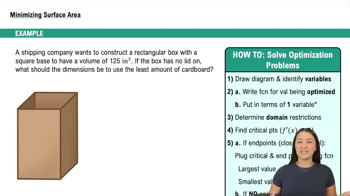
Surface Area of a Cube

The surface area of a cube is calculated as 6x^2, where x is the length of an edge. Understanding this formula is crucial because it allows us to express the surface area in terms of x, which can then be differentiated to find the rate of change of the surface area as x changes.
Recommended video:
09:07
Example 1: Minimizing Surface Area

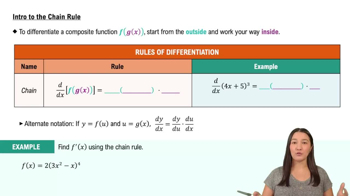
Chain Rule in Differentiation

The chain rule is a fundamental technique in calculus used to differentiate composite functions. In this context, it helps us find the derivative of the surface area with respect to time by relating it to the derivative of the edge length with respect to time. This is essential for solving related rates problems where variables are interdependent.
Recommended video:
05:02
Intro to the Chain Rule