Find an equation of the straight line having slope 1/4 that is tangent to the curve y = √x.

Ch. 3 - Derivatives
Chapter 3, Problem 3.8.10
If r + s² + v³ = 12, dr/dt = 4, and ds/dt = –3, find dv/dt when r = 3 and s = 1.
Verified step by step guidance1
Start by differentiating the given equation with respect to time t: \( \frac{d}{dt}(r + s^2 + v^3) = \frac{d}{dt}(12) \).
Apply the chain rule to differentiate each term: \( \frac{dr}{dt} + 2s \frac{ds}{dt} + 3v^2 \frac{dv}{dt} = 0 \).
Substitute the given values into the differentiated equation: \( 4 + 2(1)(-3) + 3v^2 \frac{dv}{dt} = 0 \).
Simplify the equation: \( 4 - 6 + 3v^2 \frac{dv}{dt} = 0 \), which simplifies to \( -2 + 3v^2 \frac{dv}{dt} = 0 \).
Solve for \( \frac{dv}{dt} \) by isolating it: \( 3v^2 \frac{dv}{dt} = 2 \), then \( \frac{dv}{dt} = \frac{2}{3v^2} \). Substitute the value of v when r = 3 and s = 1 to find \( \frac{dv}{dt} \).

Verified video answer for a similar problem:
This video solution was recommended by our tutors as helpful for the problem above.
Video duration:
5mWas this helpful?
Key Concepts
Here are the essential concepts you must grasp in order to answer the question correctly.
Implicit Differentiation
Implicit differentiation is a technique used to find the derivative of a function when it is not explicitly solved for one variable in terms of another. In this problem, the equation r + s² + v³ = 12 involves multiple variables, and we need to differentiate with respect to time t to find the rate of change of v, denoted as dv/dt.
Recommended video:
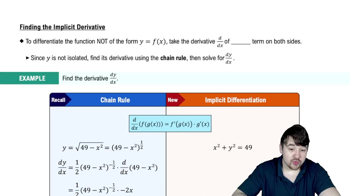
Finding The Implicit Derivative
Chain Rule
The chain rule is a fundamental principle in calculus used to differentiate composite functions. It is essential here because we are dealing with functions of multiple variables that change with respect to time. For instance, when differentiating s² with respect to t, we apply the chain rule: d(s²)/dt = 2s * (ds/dt).
Recommended video:
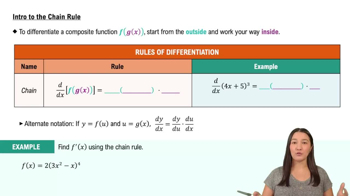
Intro to the Chain Rule
Substitution of Known Values
After differentiating the equation, substituting known values is crucial to solve for the unknown rate of change. In this problem, we substitute r = 3, s = 1, dr/dt = 4, and ds/dt = -3 into the differentiated equation to find dv/dt. This step simplifies the equation, allowing us to isolate and solve for the desired rate.
Recommended video:
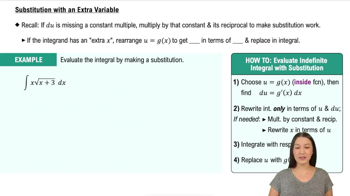
Substitution With an Extra Variable
Related Practice
Textbook Question
Textbook Question
Find dy/dt when x = 1 if y = x² + 7x − 5 and dx/dt = ¹/₃.
Textbook Question
Theory and Examples
Intersecting normal line The line that is normal to the curve x² + 2xy – 3y² = 0 at (1,1) intersects the curve at what other point?
Textbook Question
Find the derivatives of the functions in Exercises 17–28.
y = ((x + 1)(x + 2)) / ((x − 1)(x − 2))
Textbook Question
A growing sand pile Sand falls from a conveyor belt at the rate of 10 m³/min onto the top of a conical pile. The height of the pile is always three-eighths of the base diameter. How fast are the (a) height and (b) radius changing when the pile is 4 m high? Answer in centimeters per minute.
Textbook Question
Derivatives
In Exercises 1–18, find dy/dx.
y = (sec x + tan x)(sec x − tan x)