Ch. 3 - Derivatives
Hass - Thomas' Calculus 15th Edition
Hass15th EditionThomas' CalculusISBN: 9780137616077Not the one you use?Change textbook
Chapter 3, Problem 59

Find the value of dy/dt at t = 0 if y = 3 sin 2x and x = t² + π.

Verified step by step guidance
1
First, identify the given functions: y = 3 sin(2x) and x = t² + π. We need to find dy/dt at t = 0.
Use the chain rule to find dy/dt. The chain rule states that dy/dt = (dy/dx) * (dx/dt).
Calculate dy/dx. Since y = 3 sin(2x), use the derivative of sin(u), which is cos(u) * du/dx. Here, u = 2x, so dy/dx = 3 * cos(2x) * 2 = 6 cos(2x).
Calculate dx/dt. Since x = t² + π, differentiate with respect to t to get dx/dt = 2t.
Substitute dy/dx and dx/dt into the chain rule expression: dy/dt = 6 cos(2x) * 2t. Evaluate this expression at t = 0, where x = (0)² + π = π, to find the value of dy/dt.

Verified video answer for a similar problem:

This video solution was recommended by our tutors as helpful for the problem above.
Video duration:
5m
Was this helpful?

Key Concepts

Here are the essential concepts you must grasp in order to answer the question correctly.

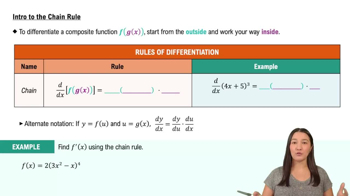
Chain Rule

The Chain Rule is a fundamental principle in calculus used to differentiate composite functions. It states that if a variable y depends on u, and u depends on t, then the derivative of y with respect to t can be found by multiplying the derivative of y with respect to u by the derivative of u with respect to t. This is essential for solving the given problem, as we need to differentiate y with respect to t through the intermediate variable x.
Recommended video:
05:02
Intro to the Chain Rule

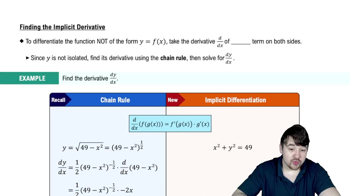
Implicit Differentiation

Implicit differentiation is a technique used to differentiate equations where the dependent and independent variables are not explicitly separated. In this case, since y is expressed in terms of x, which in turn is expressed in terms of t, implicit differentiation allows us to find dy/dt by treating x as a function of t. This method is particularly useful when dealing with relationships that are not easily solvable for one variable.
Recommended video:
05:14
Finding The Implicit Derivative

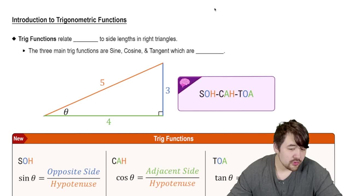
Trigonometric Functions

Trigonometric functions, such as sine and cosine, are fundamental in calculus and describe relationships between angles and sides of triangles. In this problem, y = 3 sin(2x) involves the sine function, which will require knowledge of its properties and derivatives. Understanding how to differentiate trigonometric functions is crucial for finding the derivative of y with respect to t, especially when combined with the Chain Rule.
Recommended video:
6:04
Introduction to Trigonometric Functions